





.svg)
Saudi Arabia’s latest archaeological breakthrough in the Medina province has fundamentally redefined the timeline of early Islamic epigraphy, shifting the focus of international researchers from mere discovery to a massive, long-term conservation effort.
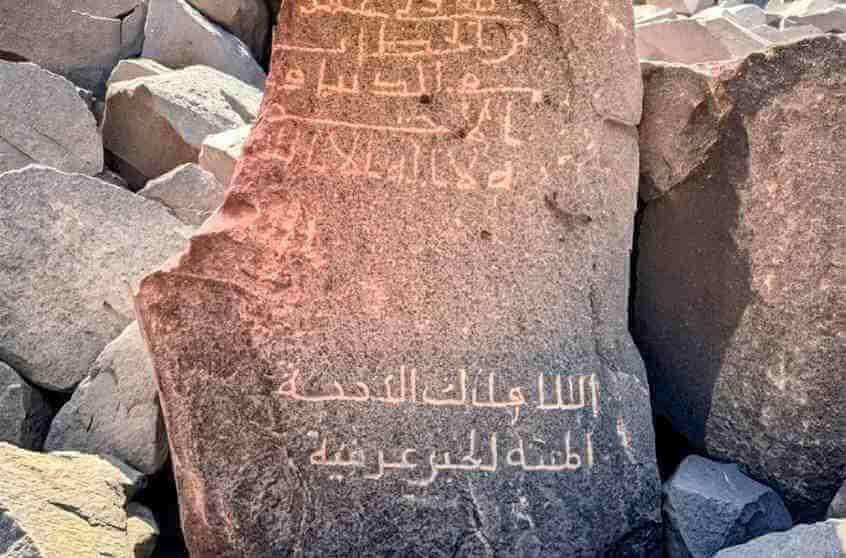
The recent unearthing of a rare stone inscription explicitly naming Islam’s second caliph, Umar ibn al-Khattab, alongside over 1,700 ancient rock carvings in the Al-Mahd region, provides an unprecedented baseline for tracing the linguistic and socio-political evolution of the early Hijaz. For the historical community, the focus has now pivoted sharply toward what happens next: an extensive digital mapping project, the establishment of protected heritage zones, and the imminent integration of these remote desert locations into global tourism routes.
Scholars analyzing the finds note that the primary inscription, carved in the rudimentary, angular Hijazi script, reads: "Allah is the protector of Umar ibn al-Khattab in this world and the Hereafter, and there is no god but Allah. Muhammad (peace be upon him) is the Prophet of Allah." Speaking to journalists, experts close to the project emphasized that this text serves as a rare contemporary legal and cultural anchor, validating the administrative presence and spiritual continuity of the early Caliphate between 634 and 644 CE.
The scope of the documentation across the Al-Suwairiqiyah, Al-Muwaihiyah, and Hadhah areas has forced a reassessment of ancient transit networks. While conventional text narrative has long recorded the Medina region as a vital conduit for trade and pilgrimage, the physical data collected—including 1,259 pieces of animal and cultural rock art, 461 Islamic inscriptions, and 34 pre-Islamic Thamudic carvings—proves that Al-Mahd was an enduring cultural hub far denser than previously hypothesized. The discovery of 173 entirely hidden archaeological sites, coupled with residential ruins, historic palaces, milestones, and functional desert wells, indicates a highly structured, permanent infrastructure designed to support large-scale trans-Arabian movement.
Daily Dazzling Dawn realised that, the immediate future of this discovery lies in a multi-phased preservation strategy aligned with Saudi Arabia’s Vision 2030 framework. Moving forward, the Saudi Heritage Commission is deploying advanced 3D scanning technology to create high-resolution digital replicas of each rock face, ensuring the fragile texts are preserved from environmental erosion. Field teams are already transitioning from exploratory excavation to erecting physical perimeter security around the newly identified sites to protect them from unregulated access.
Furthermore, urban planners and heritage tourism strategists are collaborating to incorporate these remote desert coordinates into the Kingdom's expanding cultural itineraries. This upcoming phase will involve constructing eco-friendly visitor pathways and localized information centers, transforming the harsh terrain of Al-Mahd into an open-air museum. By linking scientific preservation with international accessibility, the discovery ceases to be a static archive and instead becomes an active economic and educational asset, ensuring that the ancient stories carved into the stones of Medina continue to inform the modern world.