






.svg)
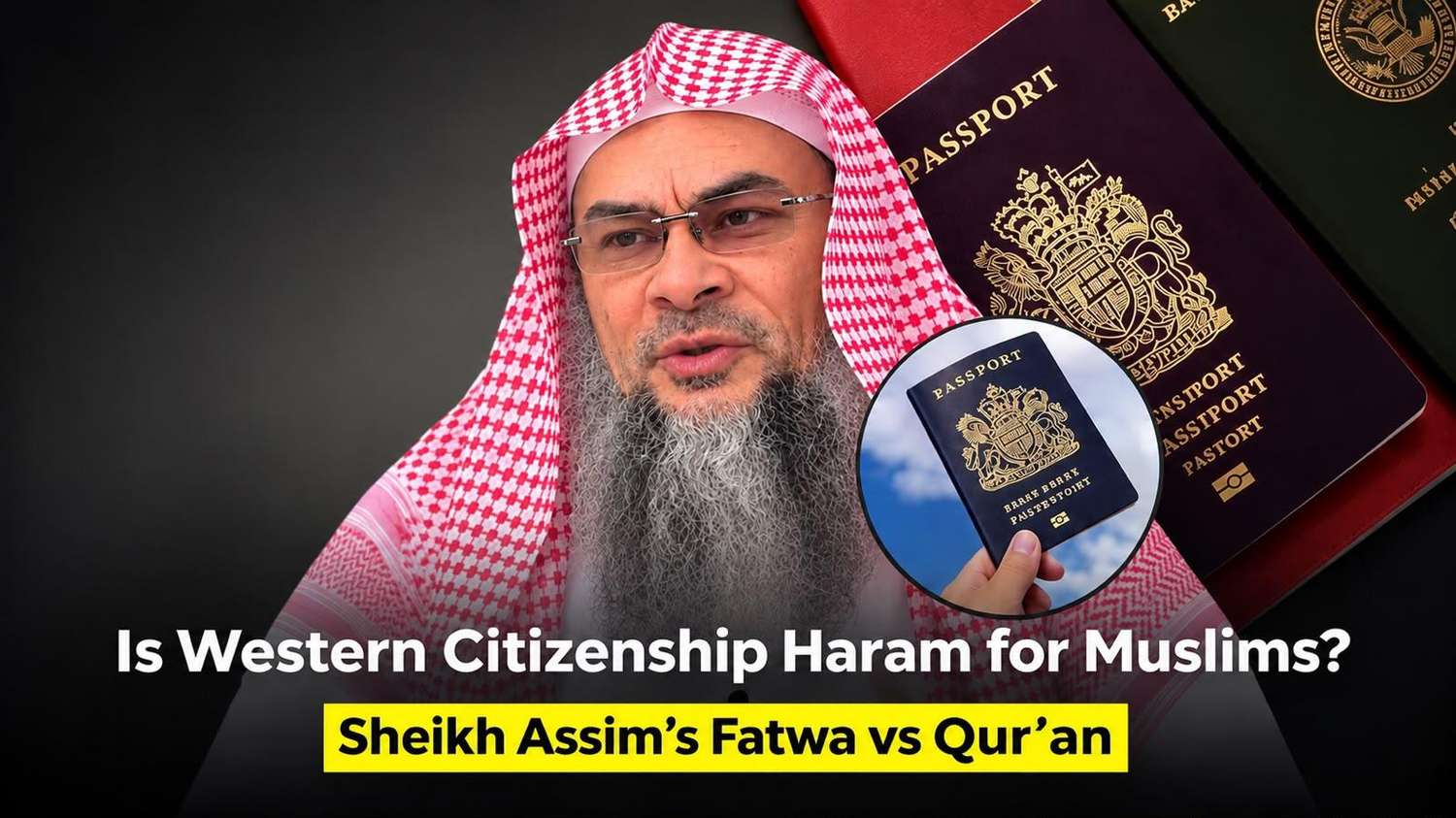
Prominent Saudi cleric Sheikh Assim bin Luqman al-Hakeem has reignited a fierce global debate across the Muslim diaspora as his November 2024 religious ruling forbidding Muslims with a Muslim-majority passport from acquiring non-Muslim citizenship currently recirculates across social media platforms. The declaration, which was originally issued on the social media platform X in November 2024 and widely shared and reported by multiple media outlets, explicitly stated that a Muslim is not permitted to take the citizenship of a non-Muslim country when he already is a citizen of a Muslim country and possesses a Muslim passport. As the controversy resurfaces now among diaspora communities, Daily Dazzling Dawn understands that the Jeddah-based preacher’s stance continues to divide public opinion. While the cleric and his supporters maintain that naturalisation in secular states compromises religious fidelity through mandatory oaths of allegiance, critics and Islamic legal analysts argue that the pronouncement conflates secondary jurisprudential deduction with explicit Qur’anic prohibition while ignoring the harsh economic and legal realities of modern migration.
Contextualising the Statement and Hadith Nuances
Across multiple televised broadcasts on Huda TV and social media exchanges reported by news outlets since November 2024, Sheikh Assim has explained the theological reasoning behind his position. Daily Dazzling Dawn learned from publicly documented lectures that the cleric views naturalisation as impermissible primarily because obtaining a Western passport typically requires an applicant to swear an oath of loyalty to a non-Muslim sovereign, ruler, or secular constitution, which he considers a compromise of a Muslim’s primary religious allegiance.
Online commentators defending the cleric’s ruling have also sought to bolster the restriction through classical prophetic traditions. One supporter of the ruling told to journalists that Sheikh Assim is right and claimed that taking such citizenship is prohibited in Hadith literature as well. However, Islamic scholars note that the classical narrations typically cited in these debates—such as the narration in Sunan Abu Dawud discouraging believers from residing among polytheists—were historically applied to active military conflict zones or territories where Muslims were barred from openly practising their faith, rather than modern secular democracies that provide constitutional protections for religious minorities. Furthermore, Sheikh Assim himself has previously defined clear exceptions to his general rule, noting in televised segments that working, studying, or earning a livelihood temporarily in a non-Muslim country is acceptable, and that the religious ruling differs entirely for individuals born in non-Muslim states or those fleeing direct oppression and mortal danger with no alternative refuge.
Gulf Migration Realities and Public Pushback
Despite those exceptions, the recirculating statement has drawn sharp pushback from Muslims worldwide who highlight a practical contradiction between the cleric’s expectations and the restrictive naturalisation frameworks of wealthy Arab states. Community members reacting to the debate questioned whether the Kingdom of Saudi Arabia offers citizenship to Muslims of other countries, answering emphatically in the negative, while others remarked that ninety-nine per cent of Muslims prefer European citizenship instead of Gulf countries' citizenship because Western states provide legal permanence and equal civic rights.
A commentator highlighting the predicament of expatriate workers, speaking to Daily Dazzling Dawn, noted that while one may agree with the Sheikh in principle, almost all Middle Eastern Muslim countries do not offer citizenship to Muslim foreigners. Even when rare statutory pathways exist, meeting the criteria remains exceedingly complicated because authorities expect either a hefty capital investment or specialised skills that are difficult to meet, leaving ordinary Muslim families with no viable route to permanent residency in the Gulf.
Distinguishing Scholarly Jurisprudence from Explicit Scripture
Beyond geopolitical frustrations, the controversy has prompted a rigorous theological inquiry into the distinction between a scholar’s legal interpretation and an explicit command from the Qur’an. Community respondents directly challenged the preacher to specify where exactly in the Qur’an Allah states that a Muslim who already holds citizenship in a Muslim-majority country is forbidden from obtaining citizenship in a non-Muslim country, requesting the specific verse and its historical context. Critics further asked Daily Dazzling Dawn whether Muslims are required to accept this ruling simply because a scholar has issued it, or whether believers are encouraged to examine the evidence and seek sound knowledge when a verdict is based on scholarly interpretation rather than an explicit Qur’anic prohibition.
Islamic legal analysts told to journalists that a scholar’s ruling and an explicit Qur’anic prohibition are not necessarily the same thing, explaining that religious rulings in Islam draw upon the Qur’an, the Sunnah, scholarly interpretation, and principles of jurisprudence. Because the modern legal concepts of nation-states and passports did not exist in seventh-century Arabia, the Qur’an contains no verse that explicitly mentions or prohibits acquiring a second passport. Instead, scholars who prohibit naturalisation rely on the theological doctrine of al-wala' wal-bara' (loyalty and disavowal) and deduce their rulings from verses warning believers against taking disbelievers as protecting allies (awliya'), such as Surah Al-Ma'idah (5:51), which mainstream exegetes contextualise around wartime military alliances and religious betrayal rather than modern civil nationality. A fair challenge, analysts noted to Daily Dazzling Dawn, is to ask the scholar to identify the specific evidence and explain how he derives that ruling from it, rather than assuming the ruling has no basis simply because a direct verse on citizenship has not been cited.
What the Qur’an Explicitly States on Authority, Knowledge, and Migration
While the Qur’an does not contain a verse prohibiting dual nationality, it explicitly addresses the foundational principles raised by participants in this debate: referring religious disputes back to divine revelation, consulting qualified scholars, and migrating across the earth when facing oppression or hardship.
Regarding the requirement to verify religious disagreements against primary revelation in Surah An-Nisa (4:59), the Qur’an states:
"O you who have believed, obey Allah and obey the Messenger and those in authority among you. And if you disagree over anything, refer it to Allah and the Messenger, if you should believe in Allah and the Last Day. That is the best [way] and best in result."
Regarding the instruction to seek clarity from scholars of sacred knowledge in Surah An-Nahl (16:43), the Qur’an states:
"And We sent not before you except men to whom We revealed [Our message]. So ask the people of the message [knowledge] if you do not know."
Regarding the permissibility of migrating across the earth when facing oppression or severe hardship in Surah An-Nisa (4:97), the Qur’an states:
"Indeed, those whom the angels take [in death] while wronging themselves - [the angels] will say, 'In what [condition] were you?' They will say, 'We were oppressed in the land.' The angels will say, 'Was not the earth of Allah spacious [enough] for you to emigrate therein?'"






.jpg)