





.svg)
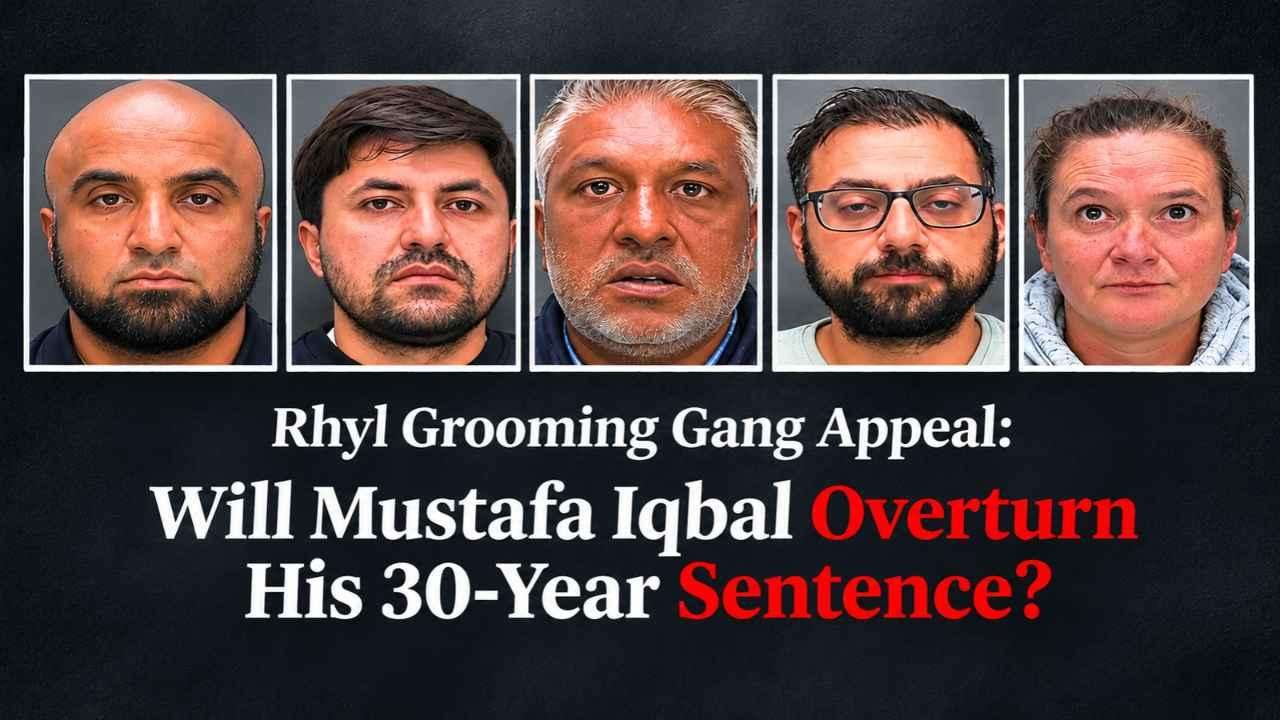
Convicted Rhyl grooming gang ringleader Mustafa Iqbal and two of his co-defendants are awaiting a decisive ruling from the Court of Appeal in London after formally applying to challenge their convictions and prison terms. Iqbal, 43, alongside Mohamed Usman Arshad, 36, and Ziaullah Badshah, 25, lodged their applications in early November 2026 following their sentencing at Caernarfon Crown Court on 25 September 2026. The legal challenges represent the latest chapter in a major North Wales Police investigation—codenamed Operation Embank and Operation Zirconium—which dismantled a coordinated child sexual exploitation and trafficking network operating across Denbighshire between April 2022 and March 2024.
Daily Dazzling Dawn understands that the three applications are currently under preliminary review by a single judge at the Court of Appeal Criminal Division. At this initial paper stage, the judiciary examines written submissions from defence counsel to assess whether arguable legal grounds exist, such as a misdirection on a point of law, procedural irregularity, or fresh evidence unavailable at trial. Should the single judge grant leave to appeal, the Crown Prosecution Service Cymru-Wales Complex Casework Unit will be required to defend the original verdicts before a full panel of two or three appellate judges.
Of the five defendants convicted of more than 40 offences in total, Mustafa Iqbal of Trellewelyn Road, Rhyl, received the heaviest custodial penalty. He is the only member of the group appealing against both his underlying convictions and the length of his sentence. Iqbal was jailed for 30 years with an additional five-year extended licence after unanimous jury verdicts found him guilty of four counts of rape, three counts of conspiracy to require a person to perform compulsory labour, three counts of sexual assault, three counts of causing a person to engage in sexual activity without consent, two counts of conspiracy to traffic, multiple cocaine and cannabis supply offences, and breaching a slavery and trafficking risk order.
As told to journalists during the September sentencing hearing, the presiding judge described Iqbal as possessing an uncontrollable sexual appetite and noted that the network viewed their three teenage victims, aged between 14 and 16, as easy prey. The court heard that Iqbal exploited the teenagers across homes, vehicles, and business premises in Denbighshire, supplying crack cocaine and cannabis in exchange for sexual acts.
Joining Iqbal in seeking permission to appeal are Mohamed Usman Arshad of Clifton Grove, Rhyl, and Ziaullah Badshah of Brighton Road, Rhyl, both of whom are contesting their convictions rather than the duration of their custodial tariffs. Arshad was sentenced to 19 years' imprisonment for three counts of rape, two counts of conspiracy to traffic, two counts of conspiracy to require compulsory labour, and supplying cannabis. Badshah received a 17-year prison term for two counts of rape, two counts of conspiracy to traffic, two counts of conspiracy to require compulsory labour, and cannabis supply. Alongside their prison sentences, Iqbal, Arshad, and Badshah were placed on the sex offenders register for life and made subject to strict Slavery and Trafficking Prevention Orders.
By contrast, Daily Dazzling Dawn learned that the remaining two members of the convicted group have not lodged appeals. Jaswinder Singh, 61, of River Street, Rhyl, is serving an eight-year sentence for two counts of conspiracy to traffic and supplying cannabis. Sarah Gray, 53, of Llanasa Road, Gronant, is also serving eight years after being convicted of assisting an offender, supplying class A and B drugs, and perverting the course of justice. Jurors heard that Gray permitted Iqbal to abuse one of the teenagers at her address in exchange for crack cocaine and later washed bedding to destroy forensic DNA evidence, prompting the judge to remark that she had effectively sold her soul.
Securing permission to overturn unanimous jury verdicts following a comprehensive Crown Court trial presents a stringent legal hurdle. The original convictions followed approximately 25 hours of jury deliberation, during which all three survivors gave direct evidence in court after targeted arrests were executed by North Wales Police on 7 August 2025. Senior Investigating Officer Detective Chief Inspector Richard Sidney and Crown Prosecution Service prosecutors previously commended the courage of the three young women for providing the crucial testimony that secured the 82-year combined custodial total.
If the Court of Appeal refuses leave to appeal, or if a full hearing subsequently dismisses the applications, the convictions and prison terms will remain entirely unchanged. Conversely, a successful challenge could result in specific convictions being quashed or sentences recalibrated. As the appellate judiciary considers the written grounds, the case remains under intense public and institutional scrutiny across Wales, underscoring ongoing debates over multi-agency child safeguarding and the prosecution of organised exploitation networks in Denbighshire.






.jpeg)