.jpg)
_1.jpg)




.svg)
The sentencing of 33-year-old Miles Cross to 14 years in prison at Mold Crown Court marks a chilling milestone in British judicial history. Cross, who pleaded guilty to four counts of intentionally encouraging or assisting suicide, is believed to be the first individual in the United Kingdom successfully prosecuted for using anonymous online forums to distribute lethal chemical compounds to vulnerable strangers. While the case centers on the predatory actions of one man, it pulls back the curtain on a burgeoning national health crisis, where the ease of digital access to self-harm methods is outpacing regulatory safeguards.
The Lethal Commerce of Vulnerability
The court heard how Cross leveraged his own struggles with gambling, alcohol, and sedative addiction to infiltrate a suicide forum he described to probation officers as his "bible." Between August and September 2024, he shifted from a seeker of information to a provider of death, charging £100 for packages of an unnamed fatal chemical. His operation was chillingly efficient, utilizing QR codes for payment and shipping substances to individuals he had never met. Of the four recipients identified, two tragically ended their lives. Judge Rowlands, in his sentencing remarks, emphasized that Cross’s total disregard for the vulnerability of his victims served as a "serious aggravating feature," highlighting that the defendant’s primary motivation appeared to be a blend of financial gain and a dark obsession with the forum's culture.
A Comparative Look at the UK Crisis
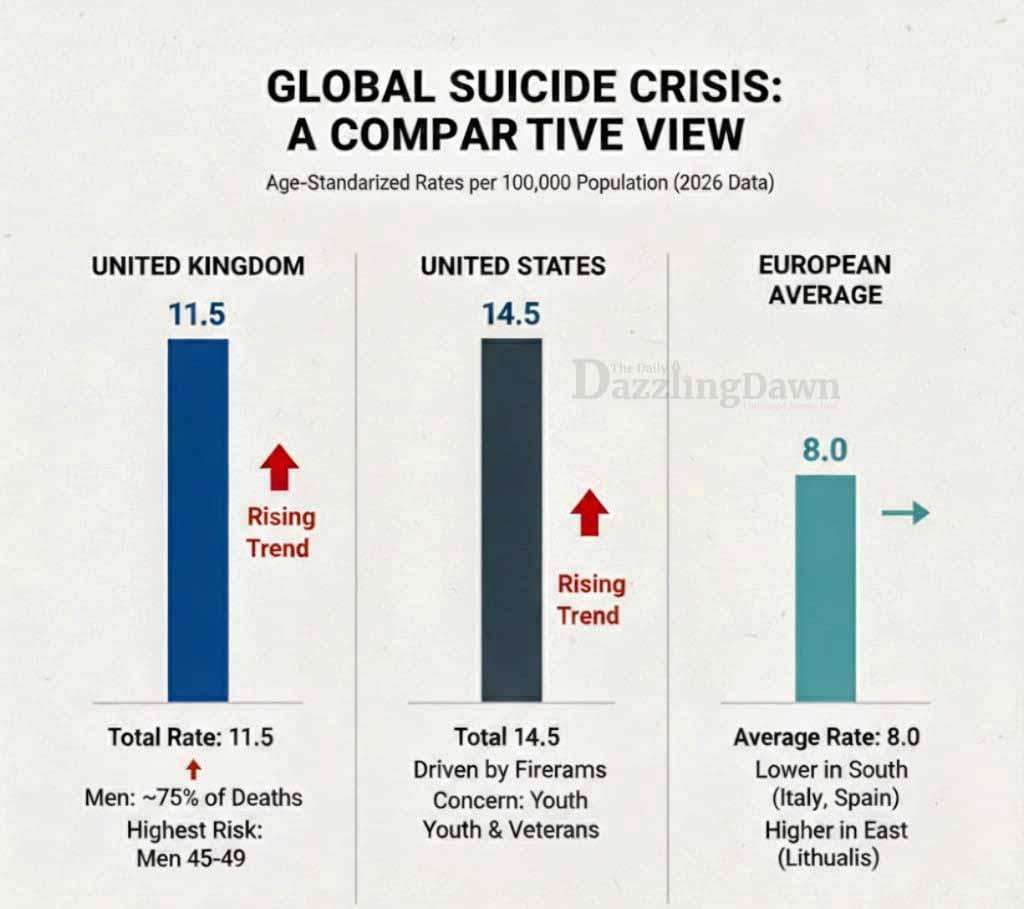
This case arrives at a time when the UK’s suicide landscape is under intense scrutiny compared to its Western peers. Current data indicates that the UK’s age-standardized suicide rate stands at approximately 11.5 deaths per 100,000 people. While this remains significantly lower than the United States, which faces an alarming rate of roughly 14.5 per 100,000 driven largely by firearm access, the UK is currently trending higher than several European neighbors like Italy and Spain, where rates often hover between 5 and 8 per 100,000. However, the UK’s figures remain below the high-incidence "suicide belt" of Eastern Europe and nations like Lithuania. The Molly Rose Foundation has noted a disturbing rise in the use of the specific poisonous substance sold by Cross, linking it to at least 133 deaths across the UK in recent years, suggesting a shift in methods that traditional prevention strategies are struggling to contain.
Demographic Realities of the British Epidemic
The profile of those most at risk in the UK remains starkly defined by gender and age. Men continue to account for approximately three-quarters of all suicide deaths in the UK, with the highest risk found among middle-aged men. Specifically, the age group of 45 to 49 currently exhibits the highest suicide rate in the country. However, the case of 29-year-old victim Shubreet Singh highlights a secondary, rapidly growing concern: a significant spike in self-harm and suicidal ideation among young adults and women under 30. This demographic is increasingly targeted by online "pro-choice" forums, where digital predators like Cross find fertile ground to exploit emotional deterioration.
Ethnicity and Religion as Risk Factors
Recent analysis by the Office for National Statistics (ONS) and independent researchers has begun to shed light on the intersection of identity and mental health. While the highest absolute numbers of suicides occur within the White population, data suggests that individuals from Mixed-ethnic backgrounds and certain Black Caribbean communities often face higher rates of mental health crises but lower rates of service engagement. Furthermore, recent trends indicate that individuals who identify as having no religion (the "nones") generally report higher rates of suicidal ideation compared to those with active religious affiliations. Among religious groups, some studies have noted that those within certain marginalized sectors of the Muslim and Sikh communities may face unique pressures, including cultural stigma regarding mental health, which can lead to late-stage interventions.
The Digital Frontier of Prevention
The conviction of Miles Cross was the result of an unprecedented collaboration between North Wales Police, the National Crime Agency, and Ofcom. This partnership was essential in closing UK access to the specific forum Cross used to source his victims. Assistant Chief Constable Gareth Evans noted that the investigation was unique in its focus on the "predatory" nature of online assistance. As the UK government continues to implement the Online Safety Act, the Cross case serves as a definitive warning to those who believe anonymity shields them from the consequences of facilitating self-harm. Prevention charities like the Samaritans and the Molly Rose Foundation are now calling for even tighter controls on the sale of high-purity chemicals that have no legitimate household use, aiming to close the "easy access" loophole that survivors in this case described as their greatest threat.
In the UK and Ireland, Samaritans can be contacted on freephone 116 123, or email jo@samaritans.org or jo@samaritans.ie. In the US, you can call or text the National Suicide Prevention Lifeline on 988, chat on 988lifeline.org, or text HOME to 741741 to connect with a crisis counsellor. In Australia, the crisis support service Lifeline is 13 11 14. Other international helplines can be found at befrienders.org.