






.svg)
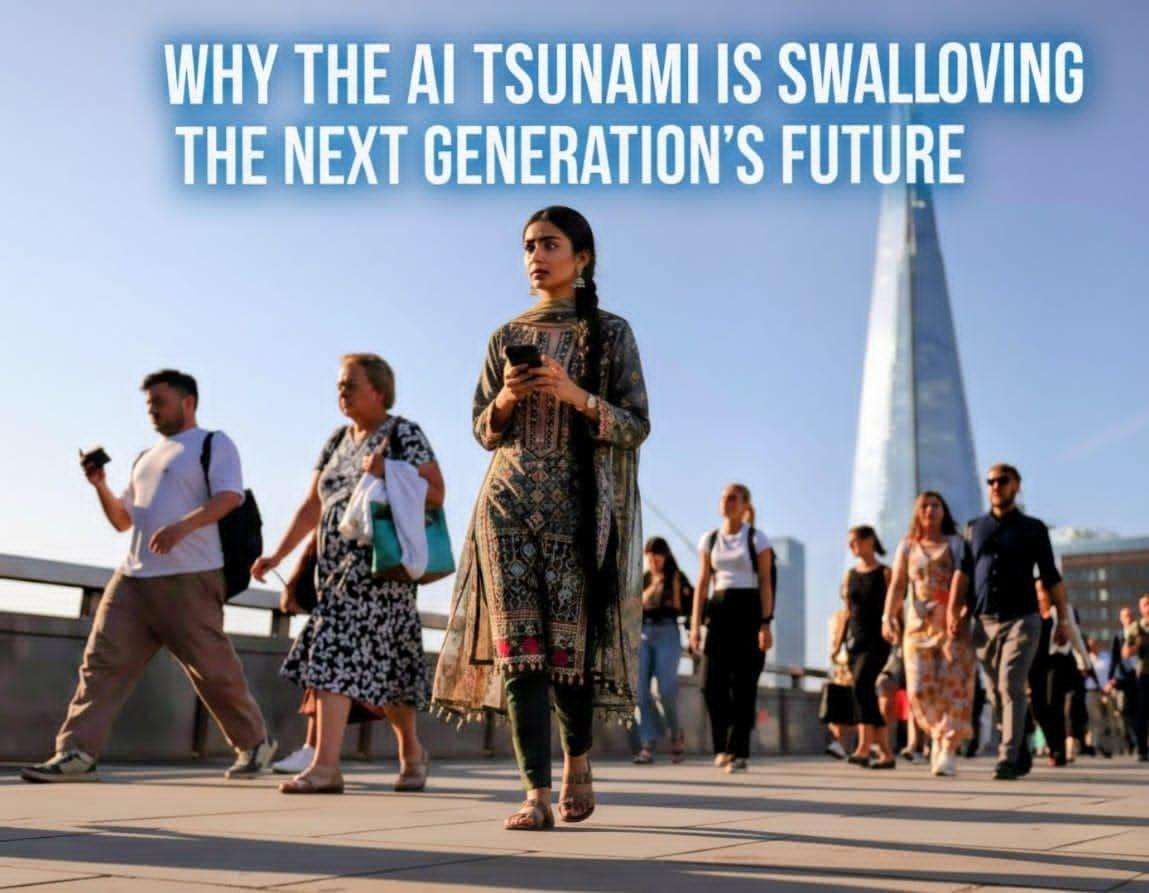
The pristine slopes of Davos have long served as a backdrop for economic prophecy, but the 2026 World Economic Forum has delivered its most chilling forecast yet. International Monetary Fund Managing Director Kristalina Georgieva has characterized the current integration of artificial intelligence not as a tool for progress, but as a "tsunami" poised to crash into the global labor market. Unlike previous industrial revolutions that targeted manual labor, this digital surge is specifically calibrated to erode the entry-level roles that serve as the traditional gateway for young professionals.
The Daily Dazzling Dawn Analysis: The Cannibalization of the Entry-Level
The IMF’s latest data suggests a staggering 60% of jobs in advanced economies like the UK and Germany will be impacted by AI within the next twenty-four months. While 10% of the workforce has seen immediate "enhancement"—largely older, senior-level executives who use AI to automate administrative burdens—the youth are being systematically locked out. The tragedy of the "AI Tsunami" lies in the nature of generative intelligence; it excels at the very tasks traditionally assigned to junior associates, researchers, and junior coders. By automating basic analysis, drafting, and data synthesis, corporations are effectively removing the "bottom rung" of the career ladder, leaving university graduates with nowhere to start.
Why the Youth are the Primary Victims of the Silicon Shift
The vulnerability of the younger generation stems from a direct overlap between their skill sets and AI’s core competencies. In previous years, a young worker traded time and basic technical proficiency for experience. Today, that trade is defunct. Recent statistics indicate that nearly 40% of global employment is exposed to some form of AI transition, but in high-income regions, this exposure is total. Young people in the UK and Europe are finding that "good placements" are vanishing because the work they would have done is now handled by a localized Large Language Model. This creates a productivity paradox: while firms report higher margins, the "middle class of tomorrow" is being hollowed out before they can even earn their first paycheck.
The Survival Blueprint: Beyond Technical Competence
Surviving this upheaval requires a radical departure from the 20th-century educational model. The youth who will thrive are those who pivot from "executors" to "architects." Survival in the 2026 economy depends on the mastery of "Human-Centric Complexity"—roles that require high-stakes emotional intelligence, ethical oversight, and cross-disciplinary synthesis. According to labor experts in Davos, the new survival strategy involves the "Hybridization of Skills," where a worker combines deep domain expertise, such as law or medicine, with advanced AI orchestration. Those who merely use AI will be replaced by those who can audit, direct, and creatively steer it.
The European Alternative: A New Continental Strategy
For the youth of the UK and Europe, the alternative to the traditional corporate ladder is shifting toward the "Sovereign Professional" model and a renewed focus on the physical and high-touch sectors. With the European Central Bank warning of deepening global inequality, many young Europeans are turning toward specialized craft, high-end technical trade, and decentralized entrepreneurship. The UK, in particular, is seeing a surge in "Agri-Tech" and "Green Infrastructure" roles—sectors where the physical world provides a buffer against digital automation. Furthermore, the push for the "Right to Human Contact" in European service industries is creating a premium market for roles that explicitly forbid AI interaction, offering a niche but stable refuge for those entering the workforce.