



.svg)
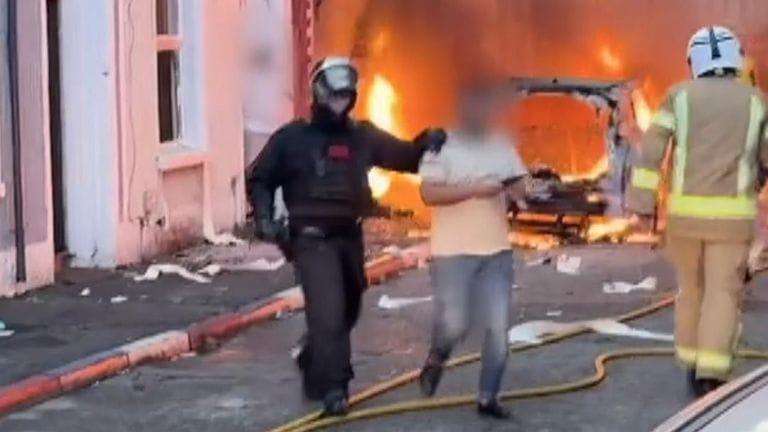
An eerie stillness has settled across the residential enclaves of Belfast, where a self-imposed lockdown has taken hold among the city’s South Asian residents. Behind tightly drawn curtains, families from Bangladeshi, Indian, and Pakistani backgrounds are living in a state of acute apprehension, terrified to step across their own thresholds. While official reporting has focused on the immediate aftermath of recent street disturbances, an ongoing investigation by Daily Dazzling Dawn reveals a deeply entrenched crisis of security that has left local minority populations effectively confined to their homes.
The atmospheric tension follows a highly publicised knife attack on Monday, which left Stephen Ogilvie hospitalised with life-altering injuries. The subsequent legal proceedings against Hadi Alodid, a 30-year-old individual who recently secured leave to remain in the United Kingdom, have acted as a lightning rod for localized unrest. Despite a stern directive from District Judge Steven Keown warning that participants in public disorder face significant custodial sentences, the psychological fallout has created an invisible barrier for long-standing immigrant communities.
For the substantial South Asian diaspora in the city, the escalation of targeted intimidation has altered the fabric of daily life. Community leaders, speaking on the condition of anonymity to protect their congregations, report that grocery shops, community centres, and places of worship have seen attendance plummet. Parents are keeping children home from school, and shift workers in essential health and hospitality sectors are refusing night duties out of fear for their personal safety.
"The anxiety is palpable," a local community representative told journalists. "People are watching the streets from their windows. There is a profound feeling that the security apparatus is stretched, and until there is a visible, sustained deterrent, staying inside is seen as the only option for survival."
This escalating domestic crisis stands in stark contrast to the explicit appeals made by the victim's family. Through political representatives, the Ogilvie family has repeatedly stressed that the actions of a single individual should not be weaponised against the wider migrant population, praising the essential contributions of foreign-born workers to the National Health Service and local infrastructure.
As the Police Service of Northern Ireland monitors digital platforms for signs of further mobilisations, the focus shifts entirely to what happens next. Intelligence suggests that rather than large-scale confrontational riots, the threat has morphed into low-level, hyper-localised harassment aimed at forcing minorities out of mixed neighborhoods. Legal experts note that the coming weeks will test the judiciary’s resolve as the first wave of individuals arrested during the disturbances face fast-tracked prosecution.
For the families currently trapped by fear, the rhetoric of political condemnation offers cold comfort. The immediate challenge for authorities is not merely clearing the physical debris from the streets, but restoring the baseline sense of safety required for ordinary citizens to resume their lives outside the home.
Strategic Framework and Legal Measures
In response to the ongoing instability, the Public Prosecution Service is actively preparing files to implement the strict sentencing guidelines outlined by the judiciary, aiming to create an immediate legal deterrent against further masked gatherings.
Concurrently, cross-community safety networks are being structured quietly behind the scenes to provide accompanied transport for vulnerable workers who are currently too frightened to navigate public transport alone.
Furthermore, specialist cyber-crime units are widening their scope to trace the local coordinators utilizing encrypted messaging apps to orchestrate flash protests outside minority-owned businesses.