.jpg)





.svg)
The School Run's Hidden Monopoly: A Black Hole for Public Finances
The business of ferrying children to school has quietly ballooned into a lucrative, de facto monopoly in the United Kingdom, where local taxi firms and new entrants are generating colossal revenues. While drivers reportedly command earnings of a hundred a day for as little as two hours of work in London, it is the government—and by extension, the taxpayer—that is incurring losses amounting to millions, Daily Dazzling Dawn realized.
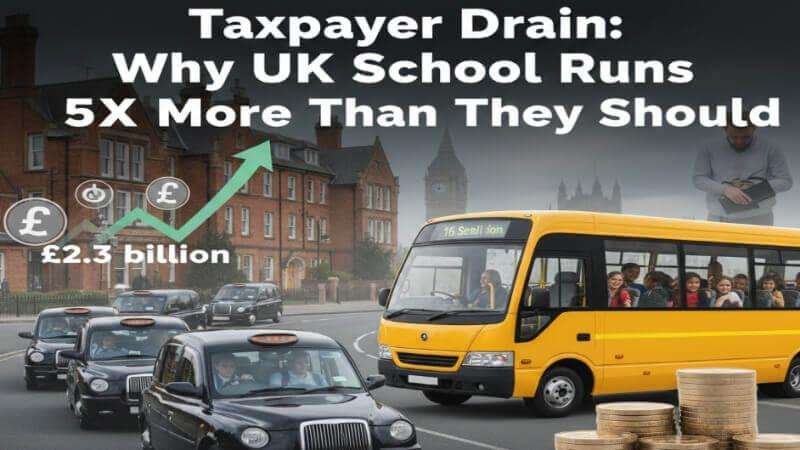
Daily Dazzling Dawn's Deeper analysis reveals that public funds are being spent like water in this sector. The annual cost of home-to-school transport in England has surged to an alarming 2.3 billion a year. This massive expenditure is not merely a service provision; it represents a significant and growing leakage of public money, largely driven by an over-provision of high-cost services.
Local authorities are legally mandated to provide free transport for children unable to walk to their nearest suitable school due to distance, special educational needs or disabilities (SEND), or safety concerns. However, the system's operational reality has transformed this duty into a disproportionately expensive model.
The SEND Driver: Five-Fold Spending on Single Taxis-The rising cost is intrinsically linked to the increasing number of children with SEND, who often require transport to schools farther from home to meet their specific needs. While children with SEND account for about 40% of the 470,000 pupils receiving assistance—roughly 180,000 pupils—councils spend approximately five times more on their transport compared to non-SEND pupils.
Heathrow Third Runway Could Shift Thousands of Regional Jobs, Government Analysis Suggests
This disparity is primarily due to the heavy reliance on single-occupancy taxis. The National Audit Office (NAO) found this is because these pupils often have to travel greater distances in individual vehicles. Further complicating this is a post-pandemic "legacy of Covid," where pupils were transported in single taxis for health reasons and families have since become "reluctant to give that up," according to leading local authority figures. This reluctance perpetuates an extremely inefficient and costly door-to-door service model.
The current descriptive language is also part of the problem. Witnesses before the public accounts committee suggested the term “home-to-school transport” sets an unsustainable expectation. Experts are now calling for a linguistic shift to “assisted travel to school,” arguing that the journey "does not have to be a door-to-door taxi service" but could involve travel to a bus stop or a walking route. This suggests that a culture of over-provision has become ingrained in the system, driving up costs unnecessarily.
The Path to Savings: Fleet Changes and Structural Reform-The most immediate and impactful reform available to government to curb this spending is a shift in vehicle capacity. The sector’s reliance on smaller, single-occupancy vehicles is the core financial drain. By mandating or significantly incentivising the use of larger vehicles—at least 12 to 16 seaters—for consolidated routes, the government could achieve significant economies of scale and dramatically reduce the overall bill.
Beyond fleet changes, there must be structural reform. This includes:
Integrated Planning: Transport and education departments must work together seamlessly to better utilise existing commercial bus services and explore the opportunities presented by bus franchising initiatives.
Managing Expectations: The renaming of the service to "assisted travel to school" would help manage parental expectations, shifting the perception away from an obligatory, bespoke taxi service.
Fair Access Based on Need: Concerns have been raised over councils cutting back on discretionary transport for 16 to 19 year-olds. A fair system based on actual need, irrespective of age, is essential to ensure continuity of education for vulnerable groups.
Parents and carers of children with SEND frequently report having to "fight for support every step of the way," finding the system complex and demoralising with unclear entitlements. This suggests that the current system is failing both the public purse through inefficiency and the families it is meant to serve through unnecessary complexity. A streamlined, needs-based, and capacity-optimised system is not only a financial imperative but a social one.