





.svg)
Beyond the Tinsel: Navigating Christmas Day as a Muslim in the West-As the festive lights illuminate the streets of London, New York, and Paris, a familiar quietude settles over the Muslim households of the Western world. For the British Muslim community, particularly those of South Asian and Bangladeshi heritage, December 25th presents a unique sociological landscape. It is a day where the machinery of the Western world grinds to a halt, offering a rare moment of stillness. While the theological foundations of Christmas do not align with Islamic creed, the reality of living in a multicultural society necessitates a thoughtful, nuanced approach to the national holiday.
The Theological Compass: Quran and Hadith-For the observant Muslim, the approach to Christmas is guided by the delicate balance between Maintaining Islamic identity and the Quranic mandate for kindness toward neighbors. Islam is explicit in its monotheism, as articulated in Surah Al-Ikhlas, which emphasizes the oneness of Allah. Consequently, participating in the religious rituals or liturgical celebrations of other faiths is avoided by the scholarly consensus.
However, the Quran also provides a framework for interfaith coexistence. In Surah Al-Mumtahina (60:8), Allah commands: "Allah does not forbid you from those who do not fight you because of religion and do not expel you from your homes—from being righteous toward them and acting justly toward them." This verse serves as the cornerstone for how British Muslims interact with their Christian or secular neighbors during this period. The Prophet Muhammad (peace be upon him) further exemplified this through his "Mithaq al-Madina" (Constitution of Medina), which established a precedent for religious freedom and mutual respect within a pluralistic society.
The British Muslim Experience: A Day of Family and Connection-For the British Bangladeshi and wider South Asian communities, Christmas Day has evolved into a significant secular milestone in the domestic calendar. Because the day is a mandatory public holiday where businesses, schools, and offices are closed, it inadvertently provides a rare "common window" for large, fragmented families to congregate.
In households from Tower Hamlets to Birmingham, the day is less about the tree and more about the "Dawat"—the traditional feast. The aroma of slow-cooked biryani, roast lamb, and traditional Bangladeshi fish curries often replaces the scent of pine and turkey. These gatherings serve as a vital lifeline for community cohesion, allowing elders to pass down stories to the youth and cousins to reconnect away from the pressures of work and study. It is a time for strengthening the "Silat al-Rahim" (the ties of kinship), a practice highly emphasized in the Hadith, where the Prophet noted that maintaining family bonds increases one’s provision and lifespan.
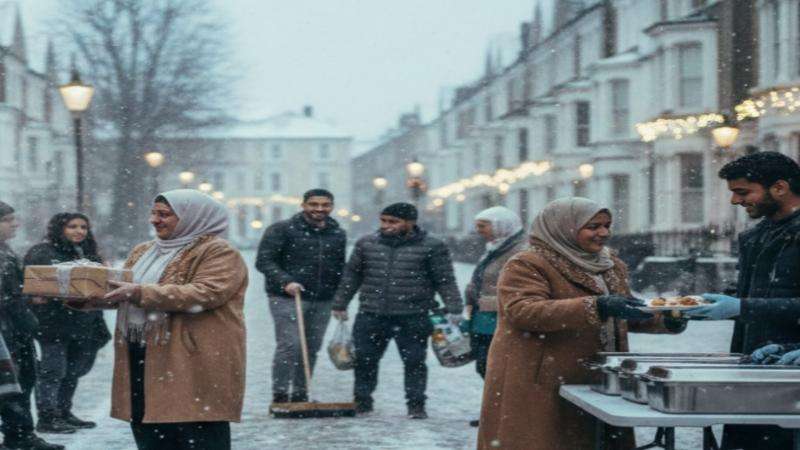
Purposeful Presence: Activity and Service-What does a Muslim do on a day when the rest of the country is preoccupied? For many in the UK and USA, the day is defined by "Khidma," or service. Across the country, Muslim-led charities and youth groups utilize the holiday to look after the vulnerable. From distributing hot meals to the homeless to visiting the elderly who may feel particularly isolated during the festive season, the community puts the Islamic principle of "Ihsan" (excellence in faith) into tangible action.
For others, the day offers a spiritual retreat. With the world outside slowed down, many use the time for extra prayers, reading the Quran, or attending intensive Islamic seminars often organized by local Masjids to cater to the youth during the winter break. It is a day of reflection, allowing individuals to recalibrate their spiritual goals for the coming year.
Voices from the Community-The sentiment on the ground is one of respectful distance blended with civic participation.
"We don’t celebrate the religious aspect of Christmas, but we value the spirit of rest and family," says a community leader from East London. "It is a day where we can be unapologetically Muslim while appreciating the peace that the holiday brings to the city. We send greetings of peace to our neighbors, ensuring they know we value their happiness, even if we do not share their faith."
Another perspective from a British Bangladeshi professional highlights the cultural synthesis: "My children understand that we have our Eids, but they also see the importance of helping our elderly neighbor, Mrs. Higgins, with her groceries on Christmas Eve. That is what Islam teaches us—to be the best version of ourselves when others are celebrating."
A Model of Coexistence-The Muslim experience of Christmas in the West is not one of conflict, but of conscious navigation. By adhering to the prophetic tradition of neighborliness without compromising the core tenets of "Tawhid" (the Oneness of God), the community demonstrates that it is possible to be both a devoted Muslim and a contributing member of a Western society.
As the sun sets on December 25th, the British Muslim home remains a sanctuary of faith and family. The day serves as a reminder that while the calendar may be marked by different festivals, the values of compassion, charity, and kinship are universal threads that bind a diverse nation together.








.jpg)