.jpg)





.svg)
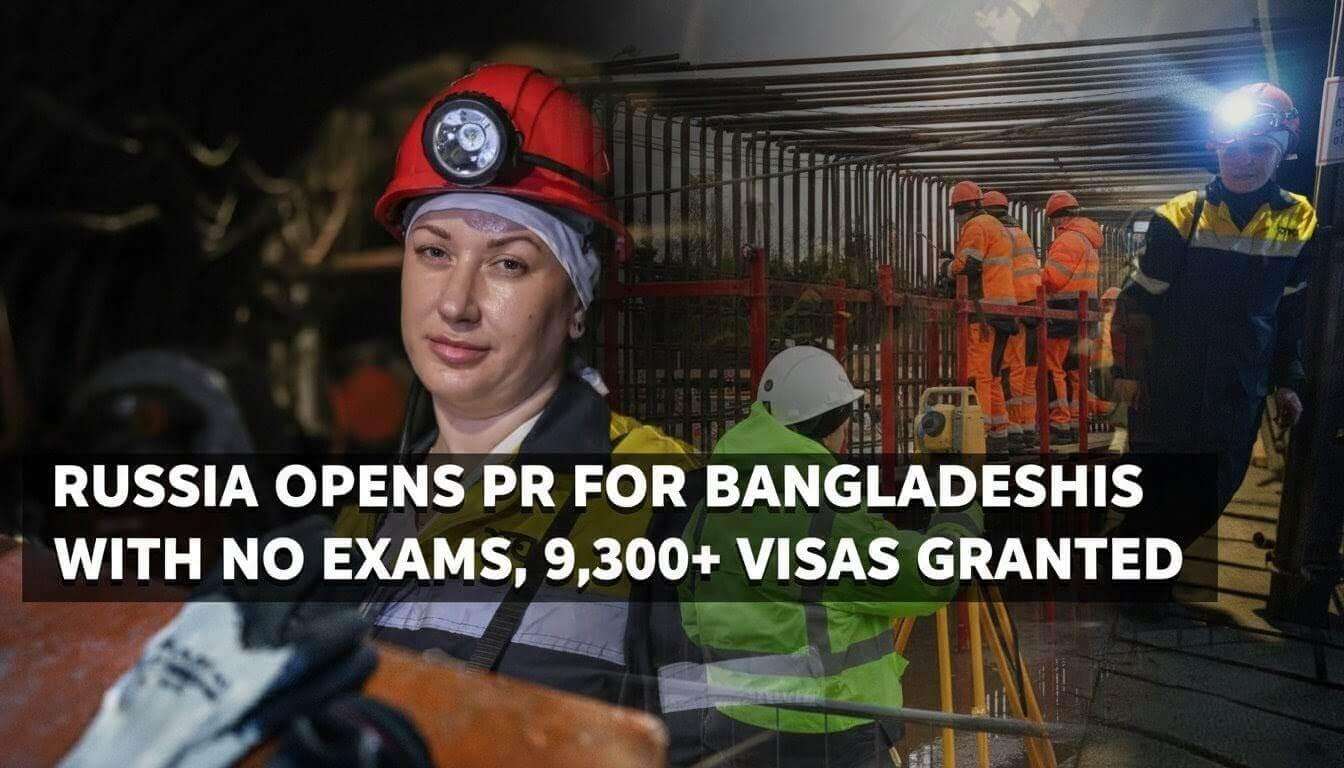
Russia is rapidly emerging as the premier destination for Bangladeshi professionals and skilled laborers, offering a more accessible and faster pathway to residency than traditional European markets. As the Kremlin grapples with a historic labor deficit of 2.6 million workers, a groundbreaking "Skilled Visa" policy set for April 2026 is poised to change the lives of thousands of Bangladeshi families, Daily Dazzling Dawn realized.
The Strategic Shift: Russia Over Europe-While European countries like Germany, Italy, or the UK impose stringent language requirements, high living costs, and years of waiting for permanent residency, Russia has flipped the script. The Russian Ministry of Labor has officially confirmed a massive 20% increase in foreign worker quotas for 2026, totaling nearly 280,000 permits. Unlike the European Union’s complex "Blue Card" or point-based systems, Russia’s new model prioritizes rapid integration. For Bangladeshi workers, this means 92% of all available spots are reserved for skilled roles in manufacturing, construction, and infrastructure—sectors where Bangladeshi expertise is highly valued.
Permanent Residency Without the Language Barrier-One of the most revolutionary updates for 2026 is the complete removal of the mandatory Russian language, history, and law exams for skilled foreign professionals. This "Simplified Procedure" allows Bangladeshi workers to apply for a three-year temporary residency or even direct Permanent Residency (PR) almost immediately upon arrival. In comparison, European PR usually requires B1-level language proficiency and 5 years of continuous residence. In Russia, the government is now legally obligated to process these residency applications within just 30 days, offering a level of stability and speed that Europe simply cannot match.
The Real Cost of Relocation and Earnings-For a Bangladeshi applicant, the financial barrier to entry is significantly lower than a move to the West. Official visa fees at the Russian Embassy in Dhaka range from BDT 9,200 to BDT 14,720 for standard work or business visas. Including service charges and documentation, the total estimated cost for a legitimate work visa remains under BDT 50,000—a fraction of the millions often paid to middlemen for European "donkey" routes. Once there, workers in construction and industrial sectors can earn significantly more than in their home country, with salaries for skilled labor often ranging from BDT 45,000 to over BDT 1,00,000 depending on the specialized trade.
Living Standards and Family Rights-Russia’s push for "global talent" includes unprecedented benefits for family members. Under the new 2026 guidelines, the spouses and dependents of skilled Bangladeshi workers are permitted to work lawfully in Russia without needing separate work permits. While European countries often restrict family reunification for certain visa tiers, Russia is actively encouraging workers to bring their families to help stabilize its population. The cost of living in major Russian industrial hubs remains considerably lower than in London or Paris, specifically regarding utilities and basic food staples, allowing for higher savings to be sent back home to Bangladesh.
The 2026 Roadmap for Bangladeshi Applicants-Starting April 15, 2026, the application process moves to a streamlined two-stage digital system. Bangladeshi professionals can first apply online from home to receive a one-year entry clearance. Upon arriving in Russia, they can immediately begin working while their PR or 3-year residency status is finalized. This "Work from Day One" policy eliminates the months of unemployment many migrants face in Europe while waiting for paperwork. As Russia targets 9,300+ Bangladeshi permits this year alone, the window for a career transformation has never been wider.
CRITICAL SAFETY ADVISORY: PROTECTING AGAINST RECRUITMENT FRAUD
While the legal pathways for skilled labor in Russia are expanding, the Bangladesh Ministry of Overseas Employment and international rights groups have issued a Severe Warning regarding predatory recruitment. As of 2026, over 18,000 foreign nationals from at least 37 countries have reported being "duped" or coerced into military service. Recent investigations reveal that "shadow agents" often promise high-paying civilian jobs in construction or logistics, only to seize passports upon arrival and force workers to sign Russian-language military contracts.
Under a recent 2025 decree, some foreign men seeking permanent residency have been pressured to choose between conscription and deportation. To ensure your safety:
Never sign any document that is not provided in a verified Bengali or English translation.
Verify all work invitations directly with the Russian Embassy in Dhaka or through the official BMET (Bureau of Manpower, Employment and Training) portal.
Beware of "too good to be true" offers for non-combat roles near border zones, as these are frequently used as "human bomb" traps for front-line deployment in the Ukraine conflict.
Legitimate skilled work permits are tied to specific civilian employers; any mention of "volunteer units" or "security forces" should be treated as a life-threatening red flag.