






.svg)
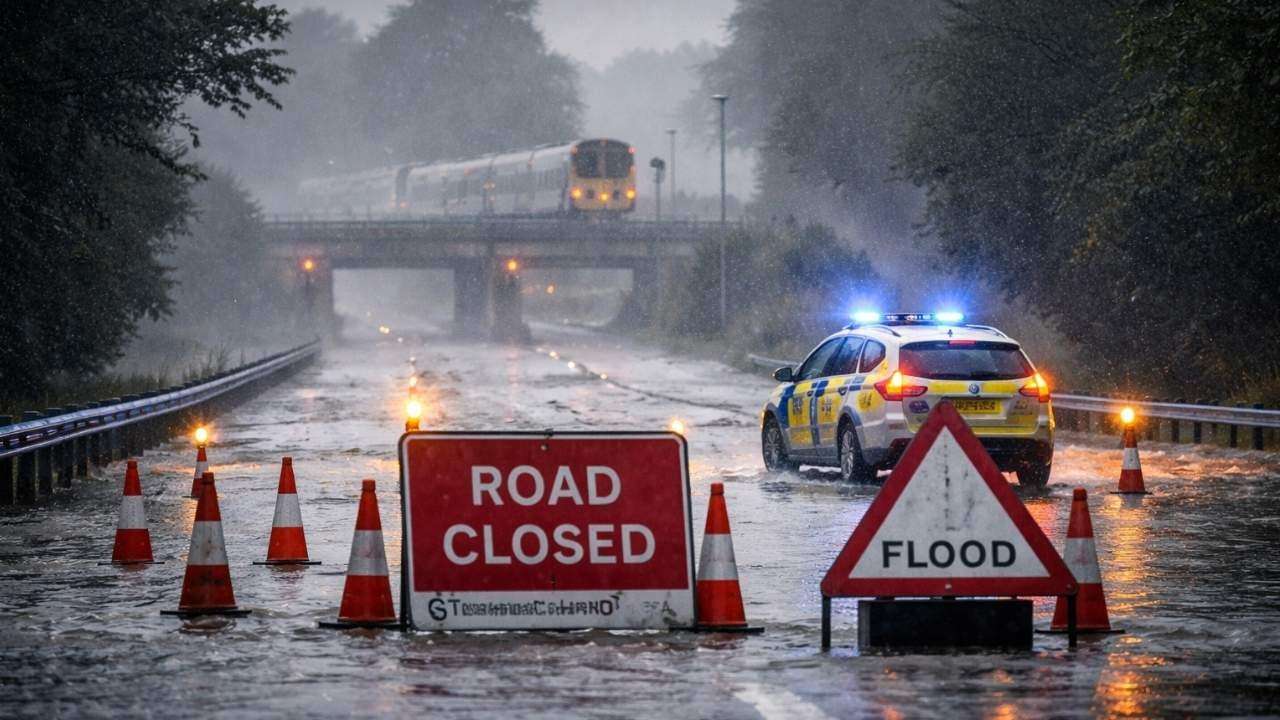
Storm Chandra caused widespread travel disruption and flooding across the UK as powerful winds and heavy rainfall swept through much of the country.
The M48 Severn Bridge was closed on Tuesday morning, while restrictions were placed on high-sided vehicles using the Humber Bridge due to strong winds. Snow was also forecast in several regions as multiple weather warnings came into effect.
British Bangladeshi Ex-Tower Hamlets Officer Pocketed £284k Across Five Roles, Southwark Hears
National Rail warned that adverse weather conditions could disrupt South Western Railway services throughout the day. Traffic travelling between England and Wales was diverted via the M4 Prince of Wales Bridge, and flooding forced the closure of sections of roads in Dorset, Somerset and eastern Devon.
Meteorologists had previously cautioned that flooding and transport disruption were likely, with significant snowfall expected on higher ground in parts of northern England and Scotland.
Several warnings remained active on Tuesday, including amber alerts for heavy rain in south-west England and strong winds along the eastern coast of Northern Ireland. The Met Office reported wind gusts of 60–70mph in eastern Northern Ireland, with coastal areas potentially seeing gusts of up to 75mph, noting that easterly winds of this intensity are rare and potentially damaging.
An amber wind warning covered the eastern coast of Northern Ireland from 5am to 9pm, alongside a yellow wind and rain warning across the rest of the region for the entire day.
In south-west England—still recovering from damage caused by Storm Ingrid over the weekend, which destroyed part of a historic pier—further heavy rainfall was expected. An amber rain warning was in place for south Devon, large parts of Dorset, southern Somerset and south-east Cornwall until 9am, with 30–50mm of rain forecast widely and up to 60–80mm possible over higher ground such as south Dartmoor.
Yellow warnings were issued for a broader area of southern England, as well as parts of northern England and Scotland. Additional yellow wind warnings covered Cornwall, south-west Wales and northern Devon, while south-west Scotland faced similar conditions throughout the day.
Waterford Murders: English Family Previously Petrol Bombed as Multiple Searches Seek Killers?
Rain and snow warnings were also issued for the Pennines and south-west Scotland, where 2–5cm of snow was expected, with accumulations of up to 10–20cm on higher ground. Central Scotland was also placed under a yellow warning for rain and snow.
Further yellow rain warnings were active across much of south-east England, south-west England, and parts of Wales.
By early Tuesday, 69 flood warnings were in force across England, mainly in the south-west, with four in Yorkshire. Scotland saw flood warnings for Aberbothrie and the River Isla at Coupar Angus, while 17 flood alerts were issued across Wales.
Met Office chief forecaster Paul Gundersen said strong winds would initially affect the Isles of Scilly, western Cornwall and south-west Wales—areas still vulnerable following Storm Goretti—with gusts of up to 80mph possible. He warned that heavy rainfall on already saturated ground increased the risk of flooding, while interaction with colder air further north would bring hazardous snowfall to higher elevations.
He urged people to stay informed and monitor local forecasts and warnings due to the complex weather conditions.
RAC mobile servicing team leader Nick Mullender warned that flooding would make many roads dangerous, advising drivers not to attempt to cross standing water unless they were certain it was safe. He stressed the importance of slowing down, remaining alert, and avoiding unnecessary journeys, particularly if vehicles had existing mechanical issues.
Storm Chandra is the latest system to be named under the western Europe storm naming scheme shared by the UK, Ireland and the Netherlands.