





.svg)
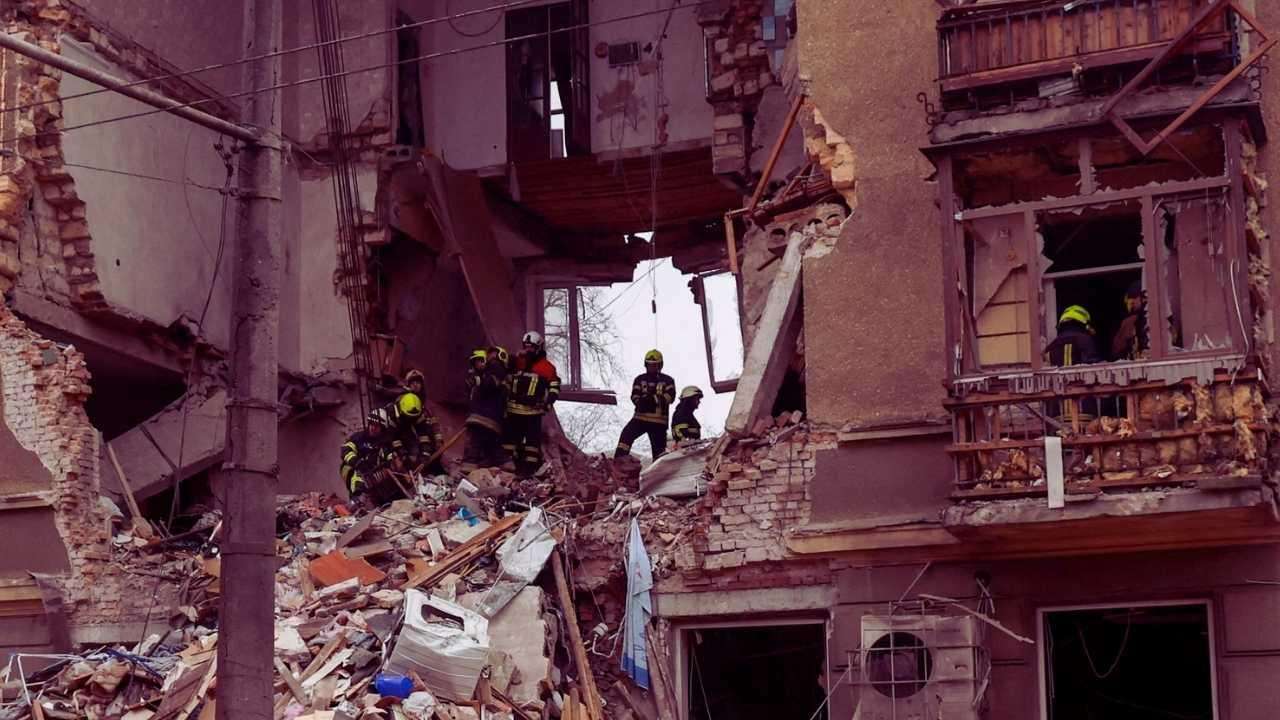
Near the Kadorr apartment complex in Odesa, a Black Sea port city in Ukraine, residents and emergency workers gather in bitter cold weather, roughly 500 metres from the coastline. A Russian drone blast has torn away part of a wall above offices on the 25th floor. Below, broken glass and debris have been quickly cleared into heaps as residents inspect vehicles crushed by falling rubble.
Anastasia, 35, who lives nearby, had previously fled Donetsk after Russian forces occupied eastern Ukraine. Now, she is once again facing the reality of war.
“I was asleep and thought it was a dream when the building started shaking,” she said. “I didn’t hear the explosion, but I heard another Shahed drone flying very loudly. It had been relatively calm since I arrived here, but lately it feels much more dangerous. I haven’t decided whether to leave yet, but I’m afraid.”
Many in Odesa share her fear. Russian attacks on the city have intensified in recent months as fighting around the Black Sea has escalated again after a period of relative stalemate.
Late last year, Ukrainian strikes on oil tankers linked to Russia’s shadow fleet, as well as attacks on the Russian naval base in Novorossiysk, were followed by renewed Russian focus on Odesa. President Vladimir Putin has long claimed the city as historically Russian and warned in December that Moscow could attempt to block its access to the sea.
Although capturing Odesa or enforcing a naval blockade remains unrealistic for Russia, Ukrainian forces previously drove Russian warships back to Novorossiysk, including the sinking of the flagship Moskva early in the war. Instead, Russia has relied on missile and drone attacks to bombard the city.
The most severe recent assault occurred on 13 December, when 160 drones and missiles struck energy infrastructure, leaving much of Odesa without electricity and water for several days. Since then, near-daily attacks have become routine.
In January, Ukrainian navy spokesperson Dmytro Pletenchuk pointed to a calendar showing almost constant attacks. “Shahed, Shahed, Shahed,” he said. By 19 January, only two days had passed without strikes.
He explained that Russia targets energy facilities repeatedly during the winter in hopes of forcing Ukraine to surrender. While Ukrainian forces have pushed Russian ships away, Russian aircraft still dominate much of the Black Sea airspace, creating what Pletenchuk described as a vast “grey zone” of roughly 25,000 square kilometres.
This standoff has turned the conflict into a long-range battle. Ukraine has targeted Russian oil shipments, while Moscow has tried to undermine Ukraine’s economy by disrupting agricultural exports shipped through Odesa’s ports.
According to Odesa’s regional governor, Oleh Kiper, the Black Sea serves both as a natural defensive barrier and a vulnerability. Unlike cities further inland, Odesa cannot rely on layered air defence systems because of its coastal exposure, making it more susceptible to drone and missile attacks launched from Crimea.
Following the 13 December attack, around 60% of the Odesa region lost electricity, heating, and water. Some neighbourhoods still experience outages lasting up to 10 hours a day.
Lt Col Denys Nosicov, who leads territorial defence units in southern Ukraine, said Russia now combines missile and drone attacks to apply psychological pressure on civilians. He added that Russia is also conducting information campaigns on social media to weaken morale.
Ukraine’s military leadership has repeatedly stressed Odesa’s importance. Army chief Oleksandr Syrski said Russia aimed to seize southern territories and reach Odesa in order to cut Ukraine off from the sea. President Volodymyr Zelenskyy echoed this, stating that Russia seeks to destroy infrastructure and cripple Ukraine’s economy by disrupting maritime exports.
Since about 90% of Ukraine’s agricultural exports pass through Odesa’s ports, shipping routes have effectively become battle zones. Military analyst Oleksandr Kovalenko described the Black Sea as both Ukraine’s economic lifeline and its greatest vulnerability.
Despite the challenges, Nosicov said Ukraine is preparing Odesa for all-round defence with anti-tank obstacles, mines, and fortified zones. He added that any Russian attempt to seize the city would likely end in disaster for Moscow.
Meanwhile, civilians continue to suffer. At the Lyceum for Construction and Architecture in central Odesa, director Igor Chernenko oversees repairs after three Shahed drones struck the school. With no heating, smoke still lingers inside the building, where over 320 students and 72 staff once studied and worked.
The attack occurred early on 13 January. A night guard sheltered in the basement reported severe shaking, and when Chernenko arrived hours later, the building was still burning.
He said he could see no military reason for the strike, suggesting Russia was trying to prevent Ukrainians from training the workers needed to rebuild the country. Two drones punched through the roof, destroying an archive dating back to 1945 and damaging nearby buildings.
“Before, attacks happened once a week. Now it’s every night,” Chernenko said. “Odesa is a jewel by the sea. Russia still believes it belongs to them, and the man leading Russia behaves like a terrorist.”