





.svg)
While global superpowers leverage the 1961 Vienna Convention to bypass local laws, the Bangladesh High Commission in London has emerged as a beacon of civic responsibility. New data from Transport for London (TfL) reveals a staggering £165 million in unpaid Congestion Charges, a debt fueled by the world's wealthiest nations. However, in a stark contrast to the trend of South Asian neighbors and Western giants, Bangladesh is not among the top offenders. The mission has successfully navigated the complexities of London’s traffic regulations by maintaining a commitment to local compliance, effectively distancing itself from the "culture of non-payment" that currently clouds the reputation of many foreign missions in the UK capital.
THE SOUTH ASIAN DIVIDE AS INDIA AND PAKISTAN FACE DEBT SURGE
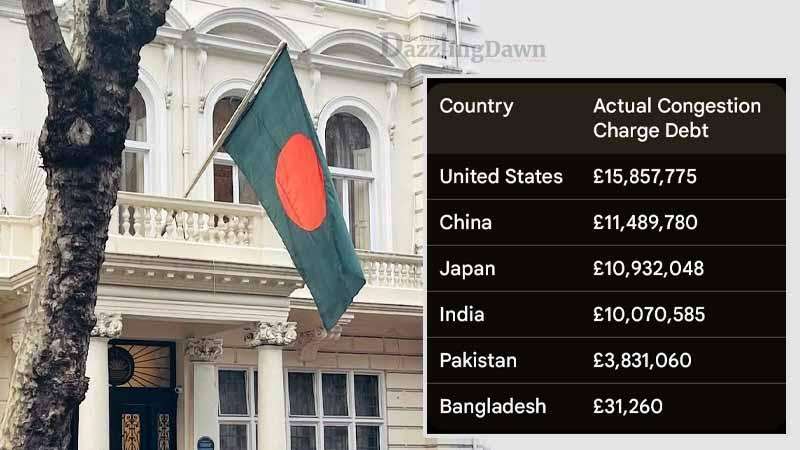
The disparity between regional neighbors is becoming impossible to ignore for British taxpayers and policymakers alike. India currently sits as the fourth largest debtor globally, with a massive outstanding balance of £10.1 million. This figure reflects decades of non-payment, positioning the Indian High Commission as a primary driver of the total South Asian debt. Pakistan also faces significant outstanding liabilities, contributing to a regional total that highlights a systemic refusal to recognize the Congestion Charge as a service fee rather than a tax. While these missions argue that the £18 daily charge is a form of taxation from which they are exempt under international law, their stance puts them at odds with the host city’s environmental and infrastructure goals.
THE SUPERPOWER STANDOFF AND THE VIENNA CONVENTION CLASH
At the summit of this financial defiance sits the United States, leading the pack with a monumental £15.9 million debt. China and Japan follow closely, owing £11.5 million and £10.9 million respectively. These nations argue that the Congestion Charge violates the 1961 Vienna Convention, which protects diplomats from local taxation. However, TfL remains resolute, categorizing the charge as a service fee for road use—no different from a parking meter or a toll road. The US Embassy has paid only 76 charges since the system’s inception in 2003, whereas countries like Saudi Arabia have attempted to balance the scales by paying over 47,000 individual charges, yet they still remain in the red due to the sheer volume of their fleet movements.
THE ECONOMIC IMPACT OF DIPLOMATIC DELINQUENCY
The accumulation of £165 million represents more than just a ledger entry; it is a significant loss of revenue intended for the modernization of London's transport network. Since the charge was introduced at £5 in 2003 and subsequently raised to £15 and then £18, the non-compliance rate has scaled alongside the price. For the average Londoner, failing to pay the charge results in a swift £180 penalty, yet foreign missions continue to operate with a perceived "get out of jail free" card. As TfL vows to escalate the matter to the International Court of Justice and the UK Foreign Office, the exemplary record of smaller nations like Bangladesh proves that diplomatic status and local law can, and should, coexist harmoniously.