






.svg)
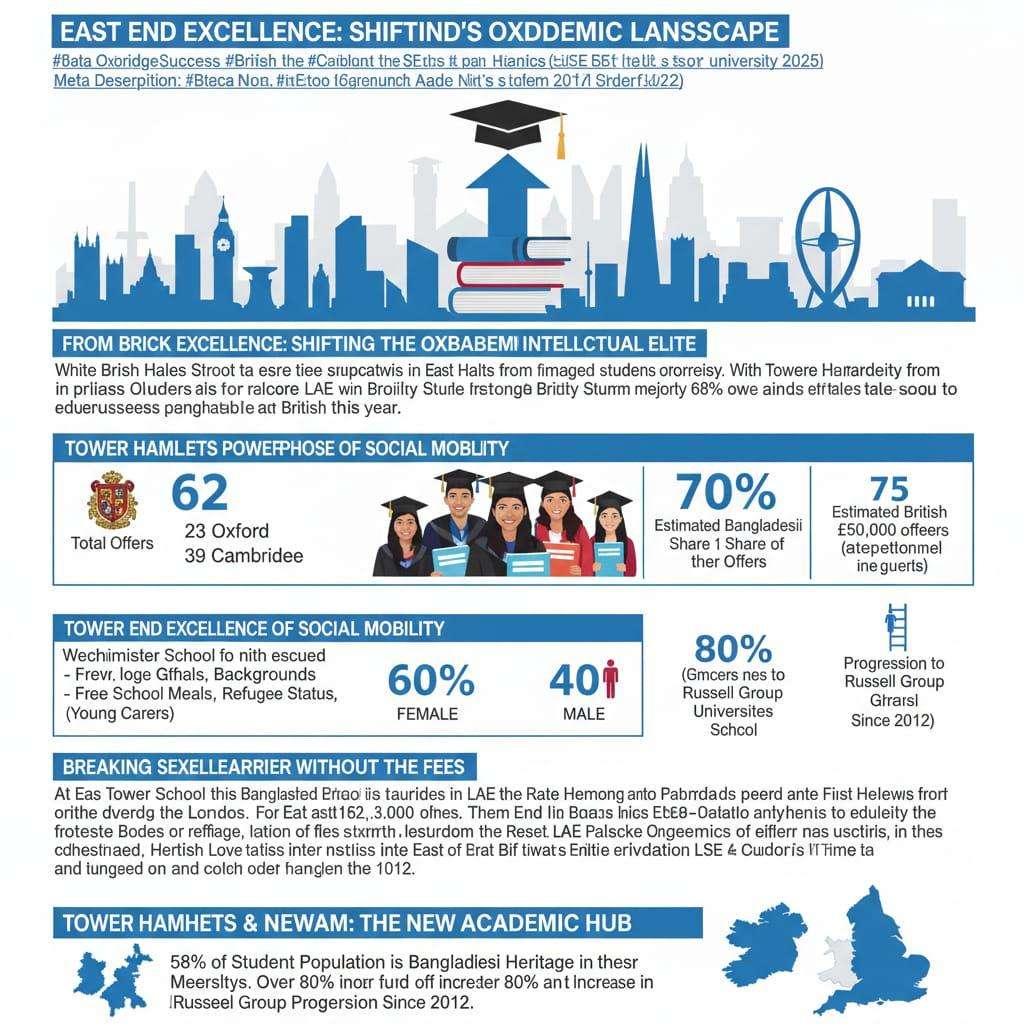
The historic dominance of private education has been breached not from within, but from the high-achieving corridors of the London Academy of Excellence (LAE) in Stratford. While the London School of Economics (LSE) has officially been named the UK’s top university for the second year running in the 2026 rankings—dethroning Oxford and Cambridge from the top three for the first time in history—the real story lies in the 62 state-school students who secured Oxbridge offers this year. Analysis of the cohort reveals a powerful demographic shift: a significant majority of these students are British Bangladeshis from the surrounding boroughs of Newham and Tower Hamlets. With approximately 60% of the offer holders being female, the "Bengali Tiger Daughter" has become the new face of British academic ambition.
Tower Hamlets: The Powerhouse of Social Mobility
Statistics from the current academic cycle underscore a remarkable trend in the Tower Hamlets and Newham corridor, where the British Bangladeshi community remains the largest ethnic group. Despite Tower Hamlets historically being one of the most economically deprived areas in the country, its students are now entering higher education at rates that challenge the UK’s wealthiest suburbs. At LAE, half of the Oxbridge-bound cohort comes from disadvantaged backgrounds, including those on free school meals, young carers, and students with refugee status. This "East End Excellence" is fueled by a profound cultural commitment to education, with the progression rate to Russell Group universities from Tower Hamlets schools reaching 81% for degree studies, a staggering increase that highlights the community's rapid ascent.
Breaking the £50,000 Barrier Without the Fees
Professional analysis of the latest data reveals a humbling reality for the UK’s elite private institutions. Westminster School, which charges nearly £50,000 annually, secured 75 offers—a figure now within striking distance for LAE, a state-funded free school. For the British Bangladeshi families of East London, many of whom will be the first in their lineage to attend university, these offers represent a dismantling of the class ceiling. The gender split remains a highlight of this success; with approximately 40 female students leading the Oxbridge charge, the community is producing a new generation of leaders in Medicine, Law, and Economics. This shift is reflected in the wider success of the British Bangladeshi diaspora, which now numbers over 650,000 and is increasingly influential in British academia and public life.
LSE Takes the Crown in a New Academic Era
As the London School of Economics secures its position as the number one university in the UK for 2026—surpassing Oxford, Cambridge, and St Andrews—the synergy between East London’s talent and the UK’s top-ranked institution is undeniable. The "Eton of the East End" is no longer just a nickname; it is a blueprint for a modern Britain. The school’s executive head teacher, Alex Crossman, noted that this success is "proof of the untapped potential" within these communities.
Nasrullah Khan Junaid, Chairman of the London-based Bangladeshi-owned institution LSCI, told the Daily Dazzling Dawn that this new shift in the educational landscape suggests a significant portion of Britain’s future leadership is emerging from Bangladeshi households in areas like Tower Hamlets and Newham.





_2.jpg)