





.svg)
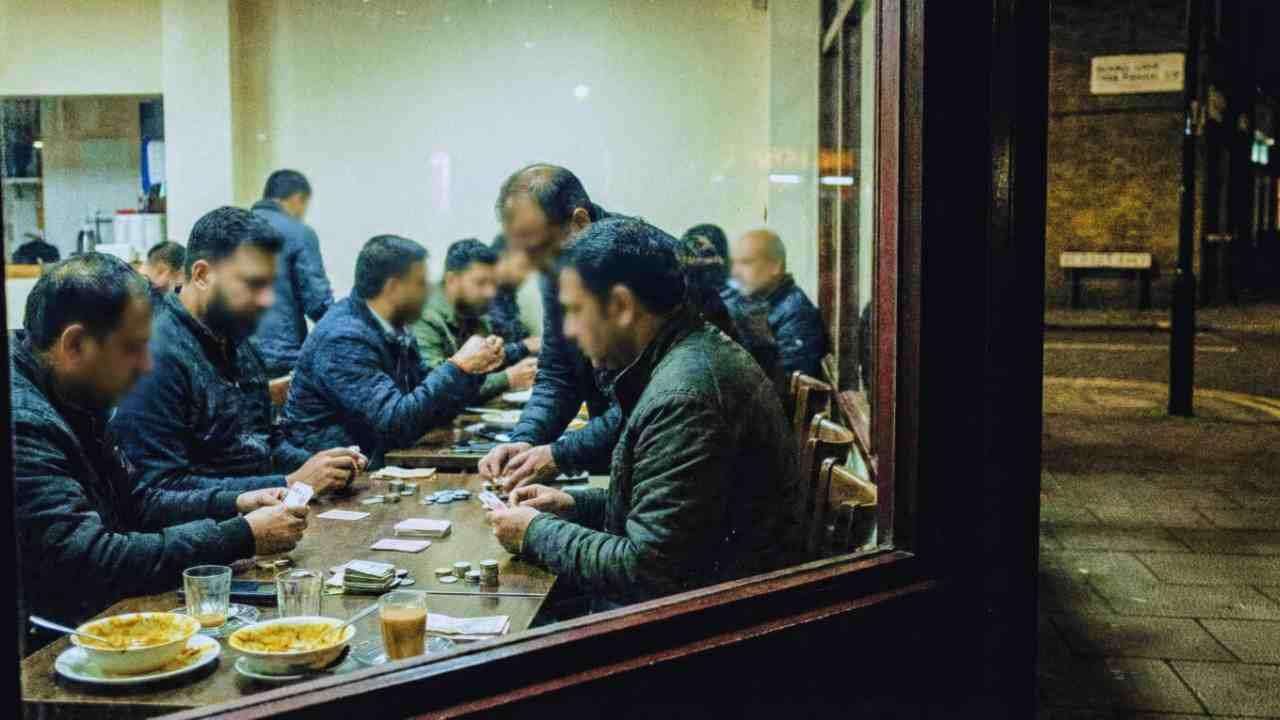
The narrative of the South Asian experience in the UK hospitality sector is often one of vibrant success, yet the reality in the London Borough of Tower Hamlets offers a stark counterpoint to the celebratory tales of West Bromwich. In the heart of the capital's Bangladeshi community, specifically along the Whitechapel Road and Brick Lane corridors, the warmth of hospitality is increasingly masking a cold, predatory reality. Reports from local sources indicate that at least two prominent Bangladeshi-owned restaurants—venues that serve families by day—are transforming after hours. Once the legitimate customers leave and the shutters come down, the dining tables are cleared to make way for unregulated card games and high-stakes betting that run deep into the night.
The "Euro-Bangladeshi" Trap
This shadow economy is being fueled by a specific and vulnerable demographic: "newly arrived" Bangladeshis who have entered the UK holding European citizenship. Often migrating from Italy, Spain, or Portugal in search of better economic opportunities, these men find themselves isolated in a new country. Seeking connection, they are drawn into these late-night gatherings which operate from evening until the "daily dazzling dawn."
For these workers, the game is not a leisure activity but a desperate financial trap. Eyewitness accounts describe scenes where entire weekly wages are wagered in a single night of cards. The adrenaline of the evening quickly turns to despair as the sun rises, bringing with it the crushing realization that they have lost everything—wages, savings, and stability—in a matter of hours. This is a predatory loop of addiction and loss occurring inside the very institutions meant to represent their community's success.
The Data: A Disproportionate Disaster
The crisis in East London is supported by alarming new data that highlights a "Harm Paradox" within minority communities. While overall participation in gambling is often lower in South Asian groups compared to the white population, the rate of harm is catastrophic for those who do participate.
According to recent figures from GambleAware and YouGov, 42% of gamblers from minority ethnic groups experience some form of gambling-related harm, compared to just 20% of White British gamblers. Furthermore, the data indicates that individuals from South Asian backgrounds are significantly more likely to fall into the "problem gambler" category, with 20% of adults from Black, Asian, and Minority Ethnic communities scoring as "at-risk," nearly double the rate of the wider population. This statistical reality suggests that the unregulated environments in East London are not just illegal venues, but incubators for a severe public health crisis.
Police Crackdowns and Intelligence-Led Operations
The Metropolitan Police and Tower Hamlets Council are increasingly aware of the link between cash-heavy high street businesses and organized crime. Recent "intelligence-led" operations have targeted commercial properties across London suspected of acting as fronts for money laundering and unlicensed activities.
Authorities are moving beyond simple licensing checks to more sophisticated enforcement strategies. The Met’s Economic Crime Unit has recently intensified its focus on "high street crime," executing warrants on businesses that serve as hubs for illicit finance. While specific recent raids on these gambling dens remain under operational secrecy, the message from law enforcement is clear: venues operating as illegal casinos face closure, heavy fines, and the stripping of their licenses. The crackdown aims to dismantle the networks that allow these venues to operate with impunity, treating them as key nodes in the wider web of anti-social behavior in the borough.
What Happens Next: A Looming Mental Health Emergency
As the police continue their "shut down" strategy, a secondary crisis is emerging that law enforcement cannot solve. Health officials and community leaders are warning of a looming mental health emergency among the "Euro-Bangladeshi" cohort. With no safety net and mounting debts, the psychological toll of these nightly losses is expected to surge. The next phase of this story will likely move from the crime pages to the health clinics, as a community struggles to heal from the silent epidemic that flourished in the dark.


.jpg)