





.svg)
In a dramatic reversal of migration trends that has caught officials on both sides of the Irish Sea off guard, the flow of asylum seekers has shifted 180 degrees. Once a sanctuary for those fleeing the threat of deportation from Britain, Ireland is now witnessing a quiet but massive exodus. Migrants are abandoning their claims in the Republic and heading north to Belfast, utilising the Common Travel Area to slip back into the United Kingdom.
This seismic shift, driven by Ireland's aggressive new "pay-to-stay" policies and a surge in rejection rates, challenges the Labour government's grip on border security just as the UK struggles to clear its own record-breaking asylum backlog.
The Great Reversal: Northbound Buses Now Full
For months, the narrative focused on migrants fleeing the UK for Ireland to escape the Conservative government's Rwanda scheme. However, since the scheme's cancellation by Prime Minister Keir Starmer and the introduction of draconian new measures in Dublin, the tide has turned.
Bus drivers at Dublin’s central station, Busaras, report a frantic increase in migrants purchasing one-way tickets to Belfast. One driver, who requested anonymity, described the scene as a complete inversion of the previous year’s chaos. He noted that while they used to see dozens arriving from the North daily, they are now "taking about 20 a week" in the opposite direction on single coaches.
The allure of the route is simple: the land border between the Republic of Ireland and Northern Ireland is virtually invisible. Under the Common Travel Area arrangements, routine immigration checks are non-existent. Once in Belfast, migrants can board ferries to Scotland or England with minimal scrutiny, effectively bypassing the UK’s reinforced Channel defenses.
Ireland’s "Hostile Environment" Drives the Exodus
The primary catalyst for this exodus is a sudden tightening of the screws by the Irish government. Facing a severe housing crisis and rising social unrest, Dublin has implemented what critics call a "hostile environment" of its own.
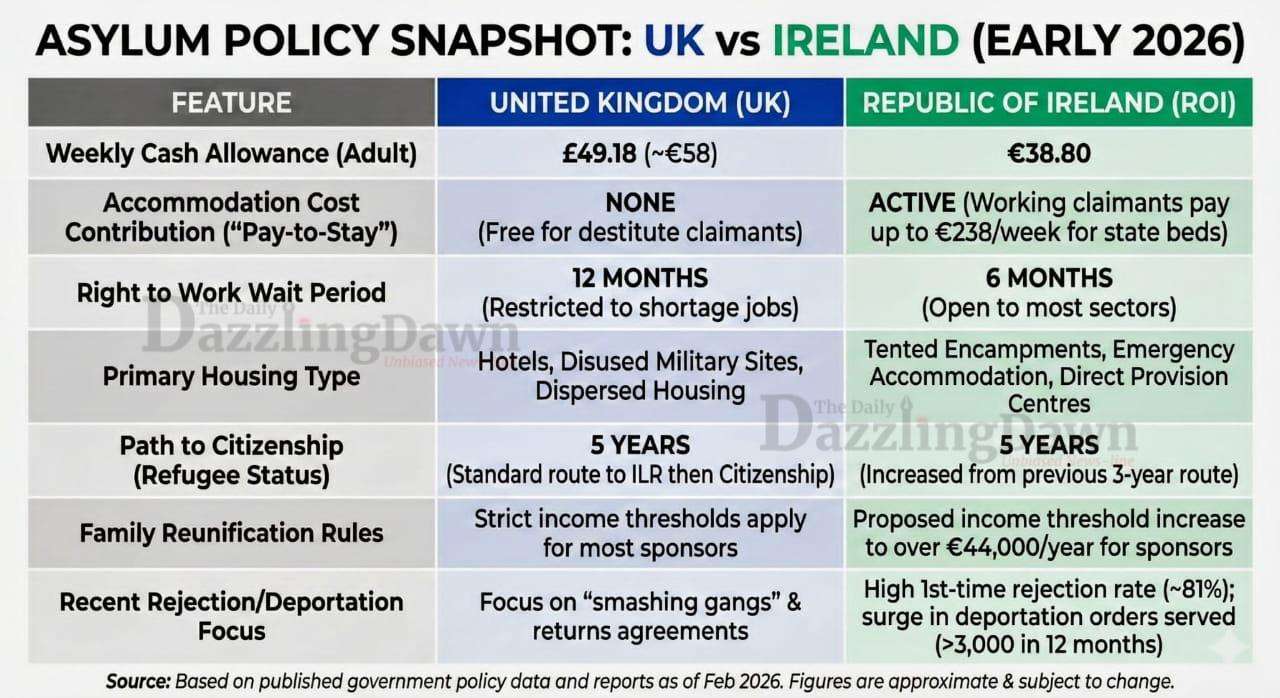
New legislation introduced in late 2025 has fundamentally altered the calculus for asylum seekers. The most contentious change is the "pay-to-stay" levy. Asylum seekers with jobs are now required to surrender between €15 and €238 per week—up to 40% of their income—to cover the cost of their state-provided accommodation. For many low-wage workers in the gig economy, this makes staying in Ireland financially unviable compared to the UK’s underground economy.
Furthermore, the path to long-term residency has narrowed. The waiting period for naturalisation has been extended from three to five years, and the income threshold for family reunification has skyrocketed to over €44,000, effectively barring most refugees from ever bringing their loved ones to Ireland.
Deportation Orders Surge as Dublin Clears House
Beyond financial penalties, the sheer rate of rejection in Ireland has sent shockwaves through the migrant community. Recent data reveals that rejection rates for first-time asylum claims in Ireland have hit 81%, a figure significantly higher than the UK’s grant rate under the previous administration.
Jim O’Callaghan, a leading voice on Justice and Home Affairs in the Irish parliament, has been blunt about the government’s intentions. He confirmed that over 3,000 deportation orders have been served in the last 12 months alone. "We believe that a very significant number of them will have left the country," O'Callaghan stated, acknowledging the reality that many are simply crossing the border rather than returning to their home countries. "They may go back into the UK or other parts of Europe if they do not get asylum here."
This admission highlights a convenient truth for Dublin: the open border with the UK is acting as a pressure valve, allowing Ireland to export its migration crisis back to its neighbour.
The UK's "Back Door" Vulnerability
For the UK government, this presents a nightmare scenario. While Home Secretary Shabana Mahmood has focused resources on "smashing the gangs" operating small boats in the Channel, the western flank remains dangerously exposed. The "back door" via Belfast undermines the UK's attempt to stabilize its immigration numbers.
Intelligence suggests that traffickers are already capitalising on this shift. Investigations have uncovered TikTok networks advertising the "Ireland Route" as the "safer, cheaper" alternative to the Channel crossing. One viral clip explicitly advises migrants: "In Europe, you survive by intelligence... this bus is the one."
With the UK’s Electronic Travel Authorisation (ETA) system rolling out to tighten external air and sea borders, the land border remains the only gap in the digital fence. As Ireland continues to tighten its grip, the UK faces the prospect of thousands of previously processed—and rejected—asylum seekers re-entering its system, untracked and undocumented.
What Happens Next: A Diplomatic Collision Course
The immediate future points toward rising diplomatic tension. Dublin is preparing to table a new International Protection Bill later this year, which promises to be even stricter, potentially including faster processing times that could accelerate the flow of rejections—and therefore the flow of people—back to Britain.
Experts predict that unless a new bilateral agreement is reached to police the Common Travel Area more rigorously, the UK may be forced to introduce spot checks at Northern Irish ports, a move that would be politically explosive. For now, the buses keep rolling North, and the "Emerald Exit" shows no sign of slowing down.