





.svg)
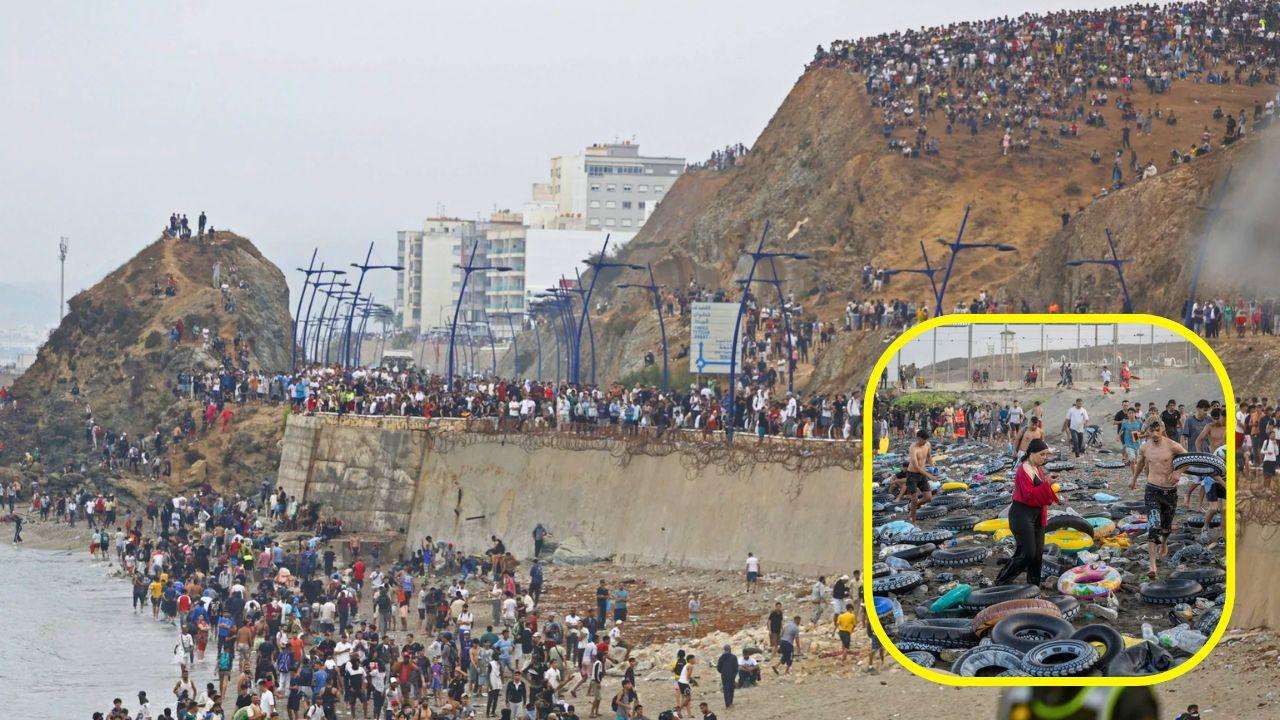
Italy has temporarily suspended the Schengen free movement agreement with Spain after raising concerns about the growing migrant crisis in Ceuta. The decision led to the closure of Italy’s sea and air borders with Spain as authorities respond to the recent surge in migrant arrivals at the Spanish enclave in North Africa.
The announcement was made on Thursday evening by Prime Minister Giorgia Meloni along with Deputy Prime Ministers Antonio Tajani and Matteo Salvini. Their decision followed the arrival of thousands of migrants in Ceuta, prompting Italy to introduce emergency border measures.
Antonio Tajani said on X that the temporary suspension of Schengen travel with Spain was necessary to protect Italy’s citizens and strengthen Europe’s external borders. He described the measure as one allowed under European treaties and said the current situation had made it unavoidable.
Tajani also argued that the crisis in Ceuta highlights the shared responsibility of all European Union countries to protect the bloc’s external borders. He stressed that member states must cooperate to stop uncontrolled migration into the EU and address any associated security concerns, including the risk of terrorism.
The decision was officially approved on Friday during a meeting at Italy’s Interior Ministry led by Interior Minister Matteo Piantedosi. The move followed recommendations from Italy’s Committee for Migration Analysis and Border Security after reviewing the latest developments.
France also announced tighter controls along its land border with Spain. President Emmanuel Macron said France would strengthen border checks while continuing to support Spanish authorities in dealing with the emergency situation in Ceuta.
Spain and the EU Respond
Spanish Prime Minister Pedro Sánchez strongly criticised Italy’s decision on X, saying that while solidarity may be a choice, respecting European treaties and established facts is not. He pointed to Frontex data showing that Italy recorded more irregular migrant arrivals than Spain between 2021 and 2026 and called for a united European response.
Spanish Foreign Minister José Manuel Albares also condemned Antonio Tajani’s proposal to suspend Schengen travel and summoned Italy’s ambassador in Madrid to explain the decision.
According to Italy’s ANSA news agency, Spain’s Foreign Ministry said the crisis in Ceuta was unrelated to the Spanish government’s migrant regularisation policy. Instead, officials said the situation was triggered by interpretations of a recent Supreme Court ruling involving migrants who entered by swimming, which criminal networks and human traffickers allegedly exploited.
By Friday, several European countries appeared to support Italy’s position, including Finland, the Netherlands, Denmark, the Czech Republic and Sweden.
Finnish Interior Minister Mari Rantanen said on X that Spain had failed to properly protect the Schengen Area’s external border and warned that the situation could not continue.
European Commissioner for Home Affairs Magnus Brunner described the developments in Ceuta as unacceptable but said he remained in close contact with Spanish authorities. He added that there was no evidence of migrants moving from Ceuta to mainland Europe or other EU countries.
Brunner also noted that the Schengen Borders Code contains special rules for Ceuta and Melilla, meaning border checks on people leaving Ceuta are already in place.
As Italy prepares for next year’s general election, the proposal to suspend Schengen has become a major political issue. The decision has also received support from several European far-right parties, including France’s National Rally, Germany’s Alternative for Germany (AfD), and the UK’s Reform UK.




.jpg)