





.svg)
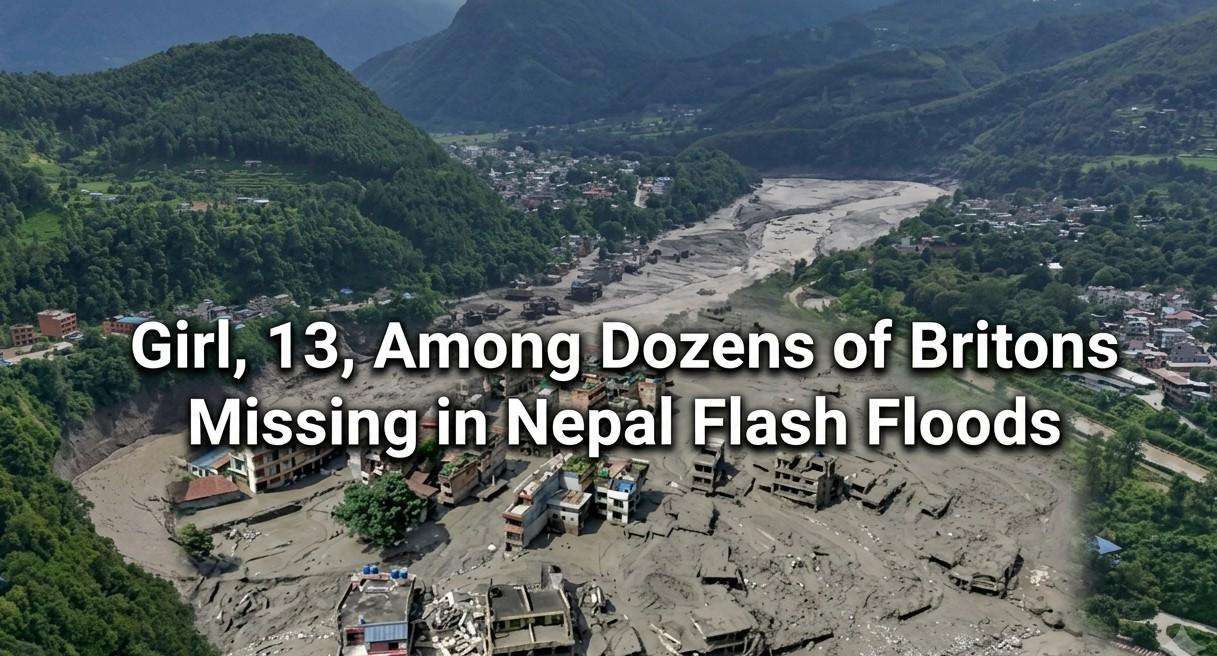
A catastrophic flash flood triggered by a sudden seismic tremor and an ensuing mountain avalanche has swept through northern Nepal, leaving more than 400 individuals unaccounted for, including thirty-three British nationals with a thirteen-year-old girl among them. The disaster struck the high-altitude border region of Rasuwa during the early morning hours on Wednesday, 26 August 2026, completely decimating critical infrastructure along the major transit corridor linking Nepal with Tibet. Emergency response agencies and international rescue teams have confirmed at least 95 fatalities across the affected river valleys, with military helicopters deployed in an urgent bid to locate survivors amidst hazardous terrain and severed communications.
According to official tourism registers examined in the capital of Kathmandu, the missing British travellers range in age from thirteen to sixty-five years old. The broader pool of missing foreign tourists stands at 341 individuals hailing from twenty-six countries, encompassing 133 Indian citizens, 47 Americans, eight South Koreans, and two Irish nationals. Search operations remain heavily constrained along the rugged Trishuli and Lhende Khola river basins, where thousands of tonnes of mud, glacial boulders, and uprooted forest cover have submerged entire hamlets and administrative outposts.
Devastation at Friendship Bridge
The epicenter of the human toll converged near the Friendship Bridge at Rasuwagadi, a vital commercial and passenger conduit situated directly on the border between Nepal and China. Local travel operators disclosed that multiple tourist contingents had assembled near the frontier crossing shortly after dawn, awaiting the scheduled opening of border clearance facilities. Witnesses reported that a sharp tremor rocked the valley floor minutes before a thunderous wall of water, ice, and debris rushed down the narrow gorge, completely annihilating the bridge and flattening border immigration facilities on both sides of the frontier.
Daily Dazzling Dawn learned that digital contact with trekking guides and tour parties ceased abruptly within minutes of the initial surge. Chinese authorities administering the adjacent Gyirong Port across the Tibetan border subsequently reported extensive damage, confirming multiple initial fatalities and over 260 people unaccounted for on their territory. The total destruction of road networks and mobile telecommunication masts has severely impeded cross-border coordination, leaving rescue teams reliant on satellite uplinks and aerial reconnaissance.
Seismic Triggers and River Blockages
Preliminary geophysical evaluations indicate that a magnitude 4.4 earthquake struck the fragile mountainous catchment area mere minutes prior to the flood surge. Addressing the national parliament in Kathmandu, Nepal's Foreign Minister Shisir Khanal stated that early technical assessments point to an earthquake-induced rock and ice avalanche that blocked the upper reaches of the Lhende Khola river. The temporary dam created by the falling mass subsequently suffered an explosive breach, releasing millions of cubic metres of trapped water down the populated river valley below.
Environmental specialists from the International Centre for Integrated Mountain Development have warned that the structural integrity of upstream gorges remains precarious. With lingering debris dams and unstable sediment blockages still lodged higher up the river system, geological monitoring units have cautioned that a secondary surge could materialise if residual meltwater pools give way. Downstream authorities in neighbouring India have already initiated proactive evacuation measures across six vulnerable districts in the border state of Bihar to mitigate the risk of sudden overflow along connecting waterways.
Emergency Rescue and Hospital Mobilisation
Nepal’s Prime Minister Balendra Shah announced that the central government has assumed full executive oversight of relief, medical triage, and emergency shelter operations. Military aviation units have thus far airlifted more than 250 injured survivors out of the disaster zone, shuttling casualties directly to specialized trauma units across Kathmandu. Additional hospital capacity, including dedicated bed space at Bir Hospital, has been mobilised to address the severe influx of trauma patients, among whom are several young children and an injured three-month-old infant.
Security services have also suffered substantial losses during the catastrophe, with at least 28 on-duty police personnel confirmed missing after local security stations were engulfed by the torrent. Consular officials from the United Kingdom, the United States, and India are currently coordinating with Nepalese emergency ministries to cross-reference manifest logs and verify the identities of survivors arriving at transit camps. Daily Dazzling Dawn understands that specialised alpine rescue units and sniffer dog teams are being dispatched toward Rasuwa as heavy earth-moving equipment attempts to clear blocked arterial highways leading into the remote Himalayan valleys.