



.svg)
Bangladesh has called on the international community to ensure predictable, adequate and coordinated financing to confront the escalating triple planetary crisis—climate change, biodiversity loss and pollution—warning that climate-vulnerable nations cannot shoulder the burden without robust global support.
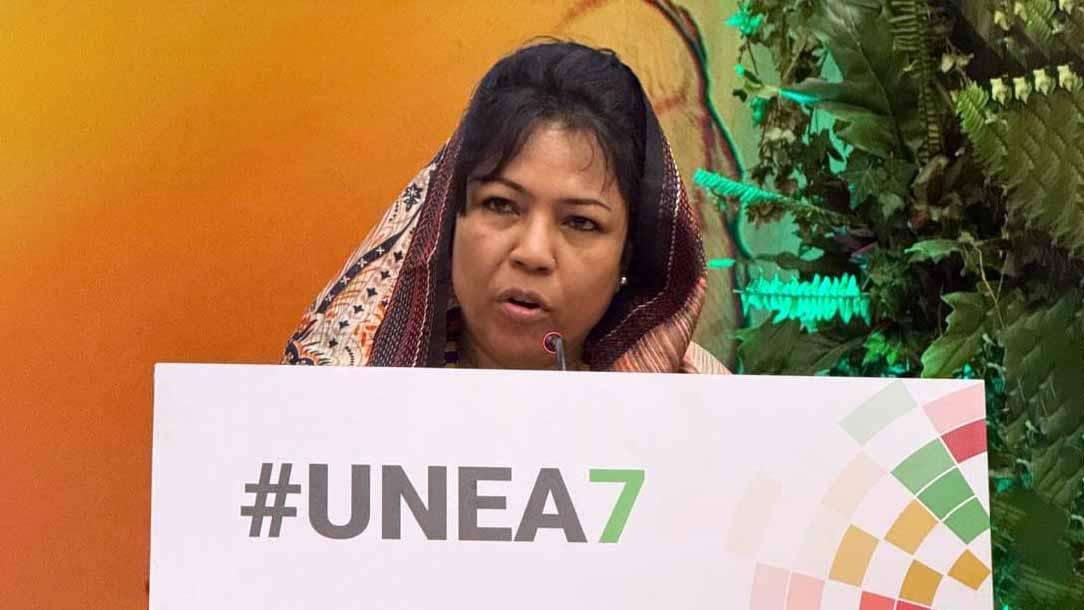
Dr. Farhina Ahmed, Secretary of the Ministry of Environment, Forest and Climate Change, delivered the appeal on Thursday while presenting Bangladesh’s National Statement at the Plenary of the 7th Session of the United Nations Environment Assembly (UNEA-7) in Nairobi, Kenya. Md. Ziaul Haque, Additional Director General of the Department of Environment, attended as part of the Bangladesh delegation.
“Climate change is a daily reality for Bangladesh”
In her address, Dr. Ahmed highlighted the severe financial strain faced by developing countries as they grapple with increasingly frequent and intense climate disasters. “In the absence of support, governments are forced to divert scarce funds from health, education and social protection towards disaster response, jeopardizing the future of generations to come,” she cautioned.
She urged UNEA-7 to help mobilize resources through multilateral environmental agreements in a coherent, synergistic manner and stressed the urgency of enhanced international solidarity. “Climate change is a daily reality for Bangladesh,” she said, referring to extreme heat, cyclones, flooding, sea-level rise and riverbank erosion—phenomena that continue to displace millions and degrade fragile ecosystems.
Bangladesh’s climate leadership despite minimal emissions
Although responsible for less than 0.5% of global greenhouse gas emissions, Bangladesh continues to demonstrate climate leadership, Dr. Ahmed noted.
She highlighted the country’s updated Nationally Determined Contribution (NDC 3.0), submitted ahead of the global deadline, which targets generating 25% of the nation’s electricity from renewable sources by 2035—five times the current level. Bangladesh is also advancing implementation of its National Adaptation Plan (NAP 2023) and expanding locally led adaptation initiatives in climate-vulnerable regions.
Pressure on biodiversity in a densely populated nation
Addressing rapid biodiversity loss, Dr. Ahmed pointed to the immense pressure on Bangladesh’s natural resources in a country of more than 180 million people. She outlined ongoing implementation of the National Biodiversity Strategy and Action Plan (2026–30), the National Conservation Strategy, Ramsar Strategic Plan (2026–30), Land Degradation Neutrality 2030 targets, and a suite of national environmental, forest and biosafety policies.
Bangladesh’s continued drive against pollution
Reaffirming Bangladesh’s pioneering legacy as the first country to ban thin plastic bags, Dr. Ahmed emphasized that “ambition works when it is backed by strong policy and public commitment.”
Malaysia Rejects Bangladesh Worker Quota Claim: Fraud Syndicate Behind False Announcement?
She noted that Bangladesh has since introduced dedicated regulations for solid waste, e-waste, medical waste, hazardous waste and ship-breaking waste management. The government has finalized Extended Producer Responsibility (EPR) directives for plastic waste, restricted certain single-use plastics, and drafted comprehensive Chemical Waste Management Rules.
Call for global action on chemicals and plastics
Dr. Ahmed urged UNEA-7 to adopt a holistic, lifecycle approach to managing chemicals and plastics, focusing on prevention, safer alternatives, circularity and the protection of informal waste-sector workers.
As climate-vulnerable countries continue to face escalating risks, Bangladesh’s message at UNEA-7 was clear: only predictable and equitable global financing—paired with technology access and coordinated policies—can enable developing nations to safeguard both people and planet.