
.jpg)


.svg)
The aftermath of London’s most expensive public order operation in decades has shifted the spotlight from the streets to the courts, as legal teams prepare to challenge the unprecedented use of live facial recognition technology against political demonstrators.
In the wake of a massive £4.5 million security operation that effectively placed central London under a state of temporary partition, questions are mounting over the long-term implications of the Metropolitan Police's tactics. While mainstream narratives focused heavily on the sheer scale of the deployment, an investigation by Daily Dazzling Dawn reveals a deeper undercurrent: the growing criminalization of peaceful dissent and the disproportionate surveillance apparatus deployed against those marching in solidarity with Palestine.
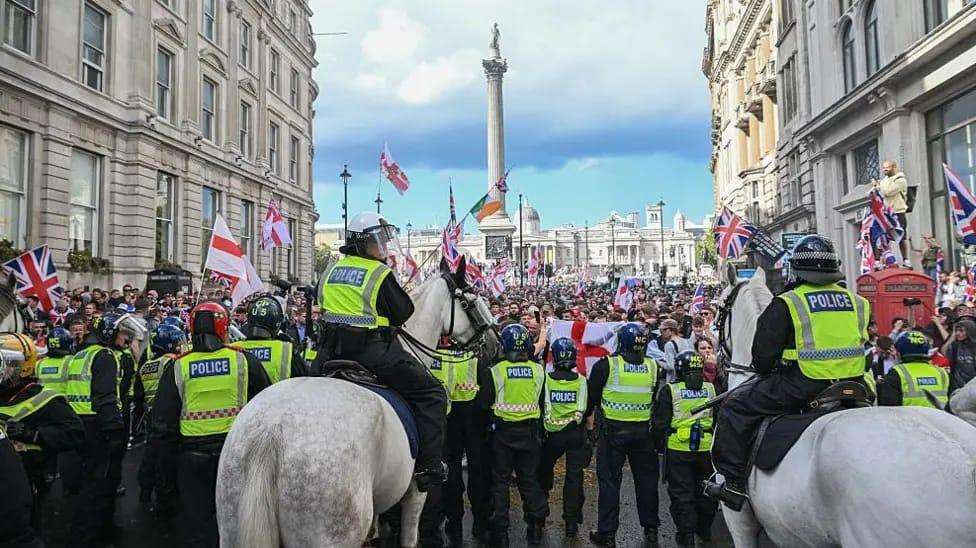
 The demonstration, held to commemorate the Nakba—the catastrophic displacement of Palestinians in 1948—faced the dual challenge of navigating a heavily fortified capital and a counter-mobilization by the far-right 'Unite the Kingdom' movement. Legal observers and civil liberties advocates are now scrutinizing the Met’s deployment of live facial recognition cameras at major transport hubs like Euston and King's Cross St Pancras. Sources close to legal defense committees told journalists that these biometric measures represent a dangerous escalation in the policing of democratic expression, potentially chilling future human rights advocacy.
Despite the hostile environment and the physical barriers slicing through historical landmarks, the pro-Palestinian march maintained a dignified, resolute presence. Participants, bearing symbols of remembrance and survival, navigated a tightly constricted route from Knightsbridge to Pall Mall. The state’s focus on maintaining a "sterile zone" frequently translated into the disruption of a legitimate memorial, yet organizers successfully ensured that the core message of Palestinian resilience remained unmarred by the provocations of counter-protesters.
The policing response, which drew over 4,000 officers including mutual aid units from Wales, ultimately resulted in 43 arrests. However, a closer look at the figures provided by the authorities reveals a telling asymmetry. Of the arrests directly linked to the rival gatherings, the vast majority of alleged hate crime offences were attributed to the far-right faction. Eleven arrests across the board involved suspected hate crimes, with nine originating from the 'Unite the Kingdom' ranks, contrasting sharply with the disciplined conduct of the Nakba commemoration.
Looking ahead, the focus of organizers is shifting toward judicial accountability. Legal challenges are being prepared regarding the necessity of deploying military-grade SandCat armoured vehicles in the heart of the capital, a move critics argue was designed to project an aura of criminality onto peaceful assembly. "The infrastructure of policing is beginning to resemble a permanent border archive," a human rights attorney told journalists, highlighting that the scrutiny will now move to how data collected during the weekend will be stored and utilized by state agencies in the months to come.
Echoes of Dissent
Daily Dazzling Dawn has learned that further solidarity actions are already being coordinated across the United Kingdom for the summer months. Activists maintain that despite the financial and logistical hurdles imposed by the state, the global movement for Palestinian rights remains undeterred by domestic political pressures.