



.svg)
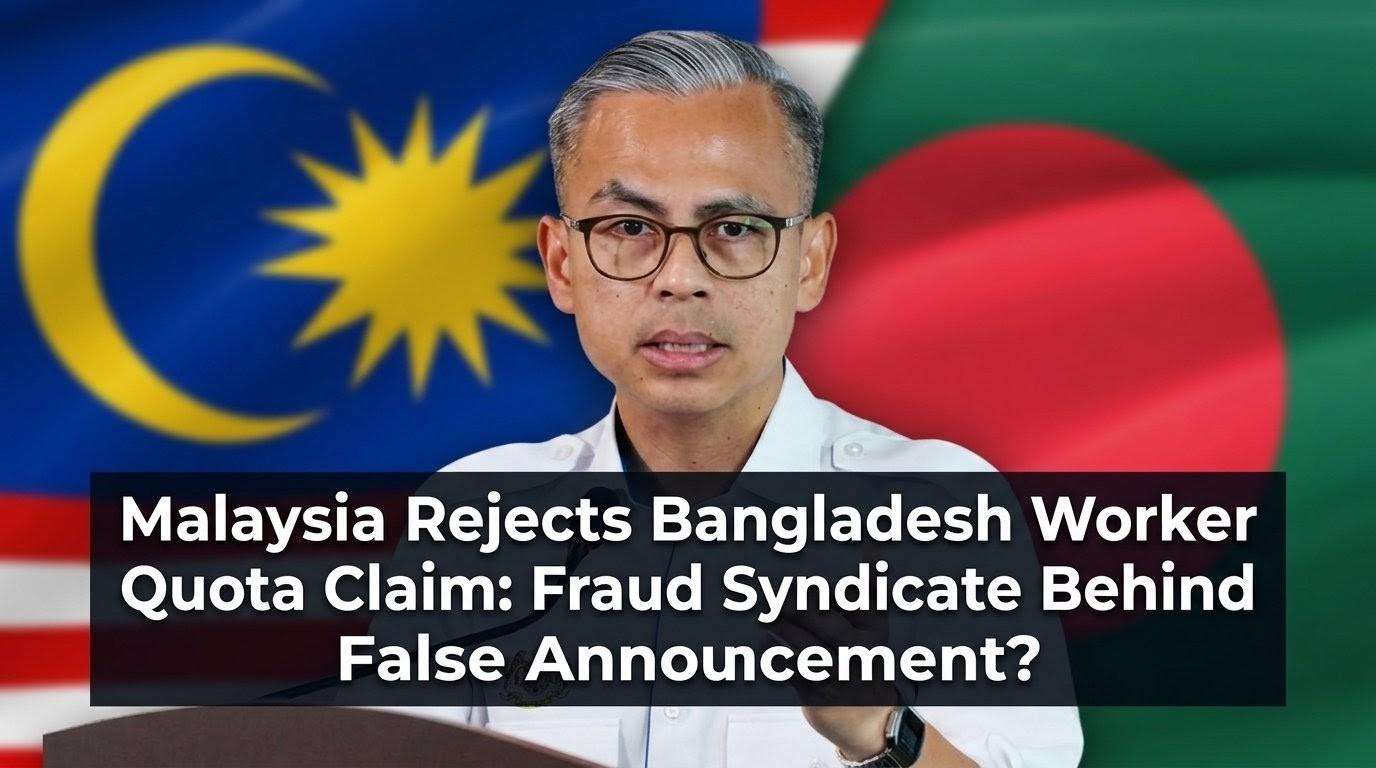
The Malaysian federal government has officially rejected claims made by Bangladeshi officials suggesting that Kuala Lumpur plans to recruit approximately 200,000 Bangladeshi workers over the next six months. Government spokesperson and Communications Minister Fahmi Fadzil clarified that the remarks, made in Dhaka, do not reflect any formal bilateral arrangement between the two sovereign administrations. Speaking following a Cabinet briefing in Putrajaya, Fahmi confirmed that inter-ministerial reviews revealed the recruitment claims originated from unauthorised diplomatic interpretations rather than mutually ratified labour policies.
The diplomatic friction began when Bangladeshi State Minister for Local Government, Rural Development, and Cooperatives Mir Shahe Alam informed domestic media in Dhaka that Malaysian employers would commence a phased intake of 200,000 workers starting in late September. His statement immediately followed a high-level courtesy call between Malaysian High Commissioner to Bangladesh Shuhada Othman and Local Government Minister Abdul Moyeen Khan. Addressing these pronouncements, Fahmi informed reporters that he had consulted directly with the Ministry of Human Resources to verify the status of any newly proposed worker intake schemes.
“I have spoken with the human resources minister about this. I have been made to understand that the statement was issued by a junior minister,” Fahmi stated to journalists, noting that Putrajaya had received no formal documentation or intergovernmental framework corroborating such an intake.
Dhaka Manpower Rumours and Syndicate Scrutiny
The sudden public claim from Dhaka has intensified widespread public debate in Bangladesh, where rumours continue to swirl concerning high-level political figures allegedly tied to illicit manpower licensing syndicates. Industry whistleblowers and local monitors have raised persistent questions over whether misleading workforce projections are being circulated to artificially inflate the commercial value of recruitment licences. Multiple unverified reports circulating across Dhaka’s migration corridors suggest that at least one Bangladeshi state minister may be covertly linked to fraudulent recruitment agencies operating within the lucrative Malaysia labour supply channel.
Recruitment rights groups and international watchdogs have repeatedly criticised the dominance of cartel-style syndicates that monopolise worker allocations between Dhaka and Kuala Lumpur. These networks have historically driven exorbitant recruitment fees, fraudulent documentation scams, and debt bondage among vulnerable low-wage labourers. Analysts indicate that premature or unfounded employment declarations frequently lead desperate job seekers to fall prey to unregistered agents and sub-brokers demanding massive financial advances for nonexistent visas.
Voluntary Repatriation of Myanmar Detainees
Beyond the bilateral migrant workforce dispute, Fahmi also addressed questions regarding regional migration enforcement, specifically responding to concerns raised by the United Nations High Commissioner for Refugees regarding the safety of displaced persons returned to Myanmar. While international humanitarian agencies cautioned that persistent armed conflict and instability across Myanmar preclude safe and dignified repatriations, the Malaysian administration maintained that its recent deportations complied fully with individual consent standards.
According to ministerial briefings cited by Fahmi, a total of 1,476 individuals transferred during the initial phase of the government's voluntary repatriation programme had formally signed repatriation documentation. The administration confirmed that immigration authorities had screened more than 5,000 individuals from a broader pool of approximately 10,000 detained Myanmar nationals. Official clearance lists were subsequently processed through the Myanmar embassy, which verified and accepted the return of the designated 1,476 detainees.
“Wisma Putra, specifically the foreign minister, has said that nothing will happen to the refugees. They will be safe in Myanmar,” Fahmi affirmed, reiterating assurances communicated by Foreign Minister Mohamad Hasan regarding consular liaison and returnee welfare.
Daily Dazzling Dawn understands that both the Ministry of Human Resources in Putrajaya and the Ministry of Expatriates' Welfare and Overseas Employment in Dhaka remain under acute international scrutiny as civil society groups demand greater regulatory oversight, transparent licensing protocols, and the absolute eradication of illicit political patronage from regional migrant recruitment channels.